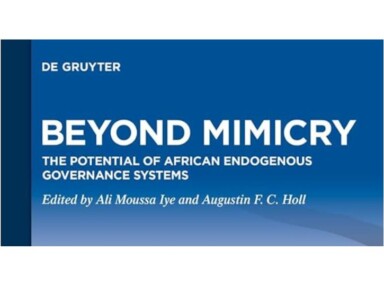
Virtual book launch: Beyond Mimicry and African endogenous governance systems
On Wednesday, 26 November 2025, the New South Institute (NSI), in partnership with Afrospectives, hosted a virtual book launch and panel discussion on “The Stakes and Challenges of Revalorising African Endogenous Systems of Governance and Justice”. The event marked the publication of Beyond Mimicry: The Potential of African Endogenous Governance Systems, edited by Professors Ali Moussa Iye and Augustin F. C. Holl and published by De Gruyter in its “Re-imagining Public Governance” series.
The webinar brought together scholars from Africa and the African diaspora to explore how African governance and justice traditions might inform contemporary reform efforts on the continent and beyond.
NSI’s histories of government programme
Opening the event, NSI Director Ivor Chipkin announced the launch of the Institute’s new research programme on the “Histories of Government”. The programme will contribute to historiographical and policy debates in South Africa and the wider Global South by tracing the development of state institutions – from national departments to regulators, tax authorities and prosecuting bodies.
Chipkin situated Beyond Mimicry within this broader effort to understand how state forms emerge over time and how governance practices might draw more seriously on local histories rather than relying predominantly on Western policy models.
Revisiting African political traditions
Professor Lisa Aubrey (Afrospectives; Arizona State University) opened the panel with reflections on how Africans in the diaspora drew on African political knowledge to build new forms of governance under conditions of slavery and colonialism. She highlighted the creation of Victoria Village in Guyana after emancipation and Quilombola communities in Brazil, where formerly enslaved Africans established their own political orders, sometimes under female leadership.
Aubrey posed a central question: from where did these communities learn statecraft? Her answer pointed back to endogenous African systems of governance – the kinds of philosophies and practices documented in Beyond Mimicry. She argued that the book shows these systems were real, legitimate and, in many cases, effective for long periods, both in Africa and in diaspora communities.
In light of ongoing governance crises and the limits of “third wave” democratisation in parts of Africa, Aubrey suggested that the task is less to invent new models than to remember, critically evaluate and renew those that were marginalised or broken by colonialism and modernisation theory.
Beyond imported models of the state
Co-editor Dr Ali Moussa Iye set out the intellectual project behind Beyond Mimicry. He described the paradox of a continent with a long history of complex political organisation that nevertheless adopted, after independence, imported models of the nation-state, democracy and justice with limited adaptation to local contexts.
Moussa Iye noted how national and continental institutions have often mirrored the organisational templates and normative frameworks of the United Nations, European Union and international financial institutions. This, he argued, raises questions about the depth of African sovereignty in the design of political and socio-economic systems.
He emphasised the decision to use the term “endogenous” rather than “indigenous” or “traditional” to describe African systems of governance and justice. “Endogenous” underscores that these knowledge systems arise from within African societies and have their own internal logics and trajectories. They should not be assessed only through the lens of Western modernity.
At the same time, he stressed that revitalising endogenous systems cannot be a simple restoration. It requires engagement with the metaphysical, philosophical and ethical foundations of African political thought, and a careful consideration of how principles such as harmony, consensus and social cohesion might be integrated into contemporary institutional designs.
Endogenous justice and public administration
Professor Benon Basheka (Kabale University) focused on African endogenous systems of justice and their relevance for public administration today. He contrasted pre-colonial arrangements – based on family structures, clan tribunals, councils of elders and spiritual authorities – with contemporary court-based systems.
In older systems, disputes were often resolved through public hearings, consensus-building and restorative remedies such as compensation, apology, community service and rituals aimed at reintegration. The emphasis fell on social harmony rather than punishment.
Basheka argued that these histories challenge the assumption that African societies lacked governance before colonisation. He noted that many features of current interest in alternative dispute resolution echo long-standing African practices. At the same time, he acknowledged tensions between certain customary norms and constitutional commitments to equality, especially regarding gender and inheritance, and highlighted the importance of ongoing judicial and scholarly engagement with these questions.
Inside Beyond Mimicry
Professor Augustin F. C. Holl provided a concise overview of the book. The volume is divided into two parts. The first examines the philosophical and historical foundations of African endogenous governance, including early human social organisation, ancient Egyptian political thought, the Manden Charter of the Mali Empire, and systems such as the Issa xeer and the Oromo Gadaa.
The second part analyses contemporary and historical efforts to adapt or revive these systems in Africa and the diaspora. Case studies include Botswana’s incorporation of traditional institutions into the post-independence state, debates around Ubuntu in South Africa’s transition, and maroon societies in Brazil and Suriname that reworked African governance practices under slavery.
The editors call for renewed research, teaching and public debate on these traditions, and for careful reflection on how their underlying principles might contribute to governance reform in the present.
Watch the recording
The virtual launch underscored growing interest in African endogenous governance systems among scholars, policymakers and practitioners across the continent and the diaspora. It also connected this agenda to NSI’s work on the histories of government and the search for contextually grounded governance reforms in the Global South.
A recording of the event is available on the New South Institute’s YouTube channel. Viewers are encouraged to watch the discussion and to engage with Beyond Mimicry: The Potential of African Endogenous Governance Systems as a resource for teaching, research and policy debate.