Ivor Chipkin discusses civil service reform and NSI’s inclusion among “100 Think Tanks to Watch in 2025” on CapeTalk
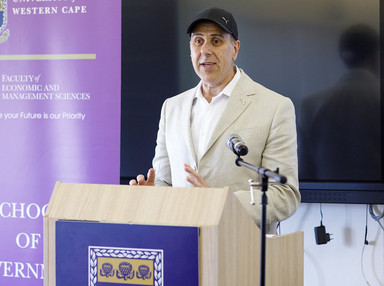
On 3 November 2025, Ivor Chipkin, the Co-Founder and Executive Director of the New South Institute (NSI), joined broadcaster Clarence Ford on his mid-morning programme, Views and News with Clarence Ford, on CapeTalk radio. They discussed South Africa’s public service reforms and the recent inclusion of the NSI on an international list of the “100 Think Tanks to Watch in 2025”, compiled by On Think Tanks (OTT). Broadcast from Cape Town to a national and online audience, the interview formed part of a segment titled ‘How African think tanks are shaping global conversations on governance and reform’. NSI named one of ‘100 Think Tanks to Watch in 2025’”.
During the interview, Mr Chipkin explained how current legislative and policy initiatives in South Africa aim to clarify the distinction between political and administrative roles within the state. He referred in particular to the Public Service Amendment Bill, which will shift powers over senior appointments towards directors-general and heads of department, and to the National Framework towards the Professionalisation of the Public Sector, which was endorsed by the Cabinet in 2022. This framework proposes a more structured recruitment process, including a universal entrance examination for the public service — a feature that has long existed in many European and Asian administrations.
To contextualise these developments, Chipkin positioned South Africa’s trajectory within the broader history of civil service reform. He drew parallels with the United States’ efforts in the early twentieth century to reduce party-political influence over the bureaucracy after the Tammany Hall era, as well as with post-Second World War public administration reforms in countries such as France and Japan. He also referenced earlier innovations in imperial China, where the distinction between political authority and a professional administrative corps was institutionalised, later informing European thinking on statecraft.
The interview focused on NSI’s selection as one of the “100 Think Tanks to Watch in 2025”, a list compiled through an international, peer-based selection process. Chipkin observed that this recognition places NSI in the company of organisations such as Chatham House, the Brookings Institution, and the Carnegie Endowment for International Peace, as well as other South African institutions, including the South African Institute of International Affairs, the Institute for Security Studies, and SouthSouthNorth. He observed that, although debates about public administration may seem technical or abstract to domestic audiences, they are attracting significant international attention due to their implications for governance and development.
In response to questions about developments across the African continent, Chipkin highlighted ongoing initiatives in countries such as Rwanda, Ethiopia, Kenya, Ghana and Nigeria aimed at enhancing civil service training and establishing more effective state administrations. He argued that, regardless of whether governments are democratic or authoritarian, the capacity of a professional civil service to implement decisions is central to economic growth and long-term planning. At the same time, he contrasted efforts in some parts of the Global South to depoliticise and professionalise public administration with emerging trends in certain Northern countries to re-politicise their civil services by reducing bureaucratic autonomy.
In the final part of the discussion, Chipkin briefly touched on wider debates about Africa’s place in an evolving global order. These debates include questions about the future of the rules-based multilateral system established after the Second World War, and the re-emergence of concepts such as ‘civilizational states’ in international political discourse.