Nicole Fritz writes in Business Day on the next NDPP and the future of the NPA
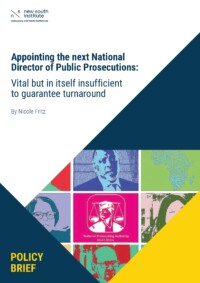
This article by Nicole Fritz was originally published in Business Day on 1 December 2025 and is republished here on the New South Institute website with permission. It draws on a forthcoming NSI report, Appointing the Next NDPP: Vital but in Itself Insufficient to Guarantee NPA Turnaround, to situate the current NDPP shortlist within a broader diagnostic of South Africa’s National Prosecuting Authority.
The Department of Justice’s announcement on Thursday of the six shortlisted candidates for the position of National Director of Public Prosecutions (NDPP) obscures a fundamental truth: South Africa is once again approaching a pivotal appointment while refusing to confront the actual condition of the National Prosecuting Authority (NPA) or the extraordinary demands that will be placed on the next NDPP.
That tension becomes impossible to ignore when one examines the shortlist.
The inclusion of former NDPP Menzi Simelane is, frankly, alarming. His earlier appointment to the position in late 2009 was declared irrational and unlawful by the Supreme Court of Appeal — a judgment confirmed by the Constitutional Court. The Ginwala Commission had raised serious concerns about Mr Simelane’s credibility, honesty and integrity; those findings could not simply be brushed aside. While the Constitutional Court stressed that this did not constitute a permanent bar to future appointment, it made clear that these findings would need to be squarely confronted – and that any future consideration of Mr Simelane would impose on him an exceptionally weighty burden of explaining why they should no longer stand in the way.
That burden now presses directly upon the Advisory Panel.
Two implications follow.
First, the interviews will need to be of an unusually exacting standard. It is imperative that the panel situate its questions within the full historical context of the NPA’s travails: the Pikoli dismissal; the Ginwala Commission; the litigation that invalidated Simelane’s prior appointment; the golden handshake given to Mxolisi Nxasana to force him out; the invalidation of Shaun Abrahams’ appointment; the fitness enquiries into Nomgcobo Jiba and Lawrence Mrwebi; the general systematic hollowing out of the NPA during the State Capture years; the dysfunction that followed the closure of the Scorpions; and the accumulated weight of public scepticism over the past decade and a half. The panel cannot simply ask candidates to perform competence. It must confront the hardest material head-on.
Second, and more unsettlingly, Simelane’s presence on the shortlist raises questions about the composition of the applicant pool itself. If a candidate carrying such a history makes the final six, what does that imply about who did not apply – or who applied but did not advance? It is possible, if difficult to imagine, that Mr Simelane may provide convincing explanations in the interview stage. But the questions his candidacy poses are not minor. They go to the heart of how seriously the process is grappling with institutional memory, legal precedent and reputational risk.
The panel has also forwarded figures with long prosecutorial histories inside the NPA, including Hermione Cronje, whose inclusion likewise demands scrutiny. Her willingness to step into the NDPP role – despite resigning from the NPA while working under the outgoing NDPP, Shamila Batohi – is telling. Whatever the reasons for her departure, they are not insignificant: they point to internal tensions, fractured trust and managerial strain within the organisation. Both these candidacies underscore a crucial point made in a report to be shortly published by the New South Institute (NSI): no assessment of individuals can be meaningful unless situated within an assessment of the institution they would be required to lead.
The NSI report argues firmly that a diagnostic of the NPA should have preceded the appointment process. The Presidency could, and should, have commissioned an institution with deep expertise in justice-sector governance, such as the University of The Western Cape’s Dullah Omar Institute, to provide a clear-eyed assessment of the NPA’s condition, its internal blockages, its areas of crisis and the reforms essential if the next NDPP is not merely to survive, but to succeed.
Without such a diagnostic, the panel risks appointing a person in no way equal to the challenges he or she will confront. The urgency of such a diagnostic becomes sharper still when one considers the parallel proceedings currently shaking the criminal justice landscape, each of which casts a long shadow over the NPA and thus over whoever next leads it.
The Madlanga Commission is currently investigating allegations made by Lieutenant General Nhlanhla Mkhwanazi that criminal syndicates have infiltrated our policing and criminal justice system at the highest levels. In Parliament, an Ad Hoc Committee is probing those same allegations. Every day, the revelations seem more lurid and absurd but the core concern, of criminal takeover, is depressingly plausible. Even putting aside allegations of direct infiltration of the NPA, if the police – the very engine of criminal investigation – are compromised, the NPA becomes the final repository for the failures of the system preceding it. An NDPP cannot lead effectively while presiding over the downstream consequences of upstream corruption and infiltration.
And within the NPA itself, the enquiry into the fitness of Andrew Chauke, suspended Director of Public Prosecutions for South Gauteng, raises vital questions about continued capture, professional standards and whether the NPA’s leadership structures retain the capacity to hold their own senior officials accountable. This inquiry is not peripheral. It speaks directly to the environment the new NDPP will enter: an environment where strained systems of accountability are being tested in real time.
Seen collectively, these parallel processes illustrate a far broader point: the crisis in South Africa’s criminal justice system is not episodic or isolated. It is systemic.
This is why the NSI report concludes that we must abandon the comforting fiction that a single appointment, however meritorious the individual, can rescue the NPA. The NDPP has been treated, repeatedly, as if she were a superhero: expected to fix case backlogs, revive units starved of expertise, restore morale, prosecute powerful figures, stabilise internal politics and withstand external ones. But the NDPP operates within a legal and institutional framework that denies her the structural power, administrative autonomy or political insulation required to achieve such expectations.
What must now happen
Recognising this, the NSI report sets out a series of immediate, practical steps that the Presidency and the Department of Justice should take to ensure that the 2025 appointment is not simply another rotation of personalities atop an unchanged institution. These recommendations do not require legislative change only political seriousness.
They include:
1. Commission a rapid diagnostic.
Engage an independent expert body such as the Dullah Omar Institute to synthesise existing evidence – from Commissions such as those led by Justices Mokgoro and Zondo, court rulings and the NPA’s annual reports – into a concise institutional health assessment to guide interviews and the President’s decision.
2. Use the internal handover.
If time is now too short for such a diagnostic, more weight must be placed on the outgoing NDPP’s comprehensive handover report. A suitably redacted version should be provided to all shortlisted candidates and to the panel, with interview questions tied explicitly to its risks and findings.
3. Disclose and interrogate priorities.
Provide candidates with the NPA’s emerging national case-prioritisation guidelines and test their approach to revising, resourcing and implementing them, especially in areas where coordination has historically collapsed.
4. Structure interviews for candour and depth.
In line with recommendations offered by organisations such as the Centre for Development and Enterprise (CDE), at least part of each interview should occur behind closed doors to allow operational and integrity questions that cannot be asked in public alone. The panel should publish a robust reasons report explaining its recommendations.
5. Close the expertise gap.
To compensate for limited prosecutorial experience on the panel, convene a focused, largely public interview with the outgoing NDPP to identify the leadership qualities most critical now, and invite written submissions from former DPPs and Deputy NDPPs.
6. Address integrity directly.
Invite the NDPP to clarify prior statements on political interference and sabotage, and to respond to allegations affecting prosecutorial leadership – including those raised by Lt-Gen Mkhwanazi relating to IDAC. This will calibrate public expectations and establish a factual baseline for candidates’ plans.
7. Set expectations with the public.
Communicate, plainly, the limits within which the new NDPP will operate and the milestones by which their tenure should be judged – ensuring the public measures success against institutional reform and sustainable prosecutorial outcomes, not heroic symbolism.
Handled this way, the 2025 process can marry transparency with substance. The next NDPP cannot alone fix the NPA but the appointment process can be arranged, even at this late stage, so that it becomes a lever for institutional recovery, and not just another turn of the wheel.
South Africa has paid the price for wishful thinking before. It cannot afford to do so again.