Organised Labour and Experts Forge Consensus to Depoliticise and Rebuild South Africa’s State
In a rare display of cross-sectoral unity, South Africa’s largest trade union federation, the Congress of South African Trade Unions (COSATU), has backed landmark legislation aimed at, amongst others, insulating public administration from political interference. This signals what advocates call a potential turning point in the country’s post-Apartheid governance journey.
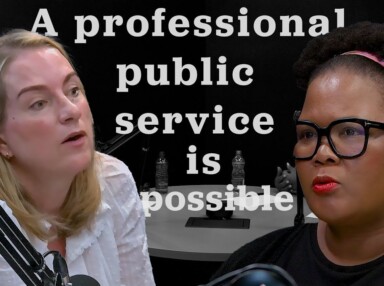
The endorsement came during a hybrid dialogue convened on 8 October 2025 by the New South Institute (NSI) at the Gordon Institute of Business Science (GIBS) campus, bringing together representatives from government, organised labour, academia, and civil society. Over 440 participants, in person and online, engaged with the day’s central focus: the Public Service Amendment Bill, a reform initiative designed to establish a professional, merit-based, and accountable state apparatus.

Mr. Matthew Parks, COSATU’s Parliamentary Coordinator, delivered a keynote address that set the tone for the event. His robust endorsement of the legislation marked a significant political breakthrough, given organised labour’s historically contentious relationship with public sector restructuring.
“COSATU supports the Public Service Amendment and Public Administration Management Amendment Bills”, Parks declared. “We believe they are fair, rational compromises that will help rebuild a capacitated developmental state”.
Parks emphasised that South Africa urgently needs an effective, well-resourced public service, not as a luxury, but as essential infrastructure for addressing the country’s profound socioeconomic challenges. He traced the roots of current dysfunction to the “decade of state capture”, which saw systematic looting and the deliberate decapacitation of institutions ranging from municipalities to state-owned enterprises.
The COSATU Parliamentary Coordinator was candid about his federation’s initial concerns. Early drafts of the bill, he shared, included what labour viewed as “constitutional overreach”, particularly a blanket ban on active participation in political activities for all 1.2 million public servants. Through extensive negotiations at the National Economic Development and Labour Council (Nedlac), the formal forum for negotiation between Government, labour, business and community organisations, the most contentious provisions were revised.
“We secured a surgical limitation of [the constraint on] political rights to Directors-General, Commissioners, and those reporting directly to them”, Parks explained. “We would not want a Commissioner of Police or SARS[1] holding political office, but we also wouldn’t want security guards, nurses, or cleaners facing such restrictions”.
Parks also highlighted other worker protections secured through dialogue: provisions ensuring that salary overpayment recoveries are conducted fairly, and requirements that employee transfers be based on mutual consent rather than unilateral management decisions.
According to Professor Onkgopotse Madumo of the University of Pretoria, the Bill’s core objective is the systematic depoliticisation of service delivery. By transferring appointment powers from Ministers to heads of department, the legislation seeks to shift from “political deployment to meritocratic appointments”.
Prof. Madumo contextualised the reform within South Africa’s broader transformation journey, noting that while the 1996 Constitution envisioned a “non-partisan, professional, and development-oriented” public service, implementation has fallen short. He cited international examples, such as Botswana, Singapore, Rwanda, and Denmark, where merit-based systems correlate with high transparency and governance indices rankings.
Ms. Nicole Fritz, Executive Director of the Campaign for Free Expression, brought the discussion into sharp relief with a case study: the 2017-2018 social grants crisis. She detailed how then-Minister Bathabile Dlamini bypassed professional officials, creating parallel “work streams” reporting directly to her, in an attempt to unlawfully extend a contract with Cash Paymaster Services, placing 17 million vulnerable South Africans at risk of not receiving critical payments.
“Had these frameworks been in place and enforced, Ministerial work streams could not have supplanted lawful authority”, Fritz argued. “Officials such as Director-General Zane Dangor would have had institutional protection rather than being sidelined”.
Professor Mashupye Maserumule of the Tshwane University of Technology provided crucial historical perspective, emphasising that professionalising the public service has been “an integral part of the very foundation of South Africa’s democracy” agreed upon during the multi-party negotiations of the early 1990s, but that has remained an “elusive pursuit” for over thirty years.
“Legislation is not a panacea”, Maserumule cautioned. “Professionalisation is a process requiring strong commitment and tenacity to purpose. Our energy must now focus on implementation modalities”.
Advocate Shukrat Makinde, representing the Public Service Commission (PSC), outlined how proposed amendments to the PSC Act would strengthen the constitutional watchdog’s oversight capacity, independence, and enforcement mechanisms, which are critical for ensuring that reforms translate into improved governance outcomes.
Throughout the dialogue, participants grappled with complex questions: How to balance professionalisation with political realities? How can reforms be extended to local government, where service delivery challenges are most acute? How can entrenched organisational cultures be shifted alongside legislative changes?
Parks pointed to SARS as proof that transformation is achievable. “SARS shows that institutions can be rebuilt when you appoint competent management, remove corrupt elements, and fill critical vacancies. It costs money today but generates far greater returns in the long run”.
With the Bill currently before the National Council of Provinces, having passed in the National Assembly in February 2024 with rare multi-party support, and with COSATU’s backing secured, reformers are cautiously optimistic. Dr Ivor Chipkin, NSI’s Director, emphasised that “effective transformation requires a shared sense of ownership across society. Public service transformation is not only an administrative priority, but also a democratic imperative”.
The October dialogue demonstrated that such ownership may finally be coalescing around a common vision: a professional, accountable public service capable of serving all South Africans.
The New South Institute is an independent research and policy organisation dedicated to strengthening democracy, public institutions, and governance in South Africa and beyond. Through evidence-based analysis and inclusive dialogue, NSI advances practical reforms that promote accountability, transparency, and social justice.