The NSI March Newsletter Is Out: Here’s What We’re Working On
South Africa’s governance crisis is now also a policy implementation challenge. The Public Service Amendment Act was signed into law on 26 March 2026. Its implementation raises practical questions about how political authority and administrative decision-making will be separated in practice. Civil servants will be expected to operate within revised institutional boundaries. Political actors will face new limits on their influence over administrative appointments and decisions. The question facing the country is no longer only whether reform is needed, but whether it can be implemented − and what consequences may follow if it cannot.
It is at this point that NSI’s March 2026 newsletter takes stock of recent work across the Institute. The collection spans governance reform, migration governance, foreign policy analysis, urban development, international law and institutional research. Taken together, it reflects the range of questions that sit behind current debates on state capacity and institutional change.
The full March 2026 newsletter is available for download and includes links to the research, interviews, working papers, events and policy briefs mentioned below.
What’s in this edition
The newsletter covers work across several areas.
On public service reform, NSI researchers are examining the implementation of the Public Service Amendment Act through academic research, public commentary and policy analysis. On migration governance, the newsletter looks at how technological change intersects with governance capacity and public trust. On south-south dialogues, it includes analysis of South Africa’s position in a shifting international order, including discussions of China’s role, BRICS+ and the practical meaning of “active non-alignment”.
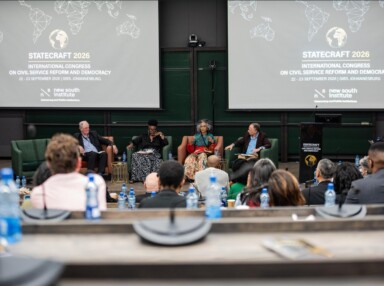
The newsletter also features work on urban development and traditional authority, institutional challenges facing the National Prosecuting Authority, research on international law and the Kosovo dispute, and NSI’s participation in international think tank networks.
The breadth of the edition reflects a basic point: Governance reform is urgent, but it cannot be understood in isolation. South Africa is also managing questions of migration, international alignment, urban form, institutional design and state capacity.
Why the structural focus on governance
Several strands of work across the Institute return to a shared diagnosis: Many of South Africa’s governance problems are structural, not only personal.
The argument is that, over time, the post-apartheid state has blurred the boundary between political office and administrative authority. Political actors have exercised influence over administrative decisions, including appointments in the public service. Government jobs and institutional access have become part of factional competition. Administrative decisions have often been shaped by political calculation. These dynamics have contributed to state capture, weakened institutional capacity, elite instability and cycles of protest linked to competition over state resources.
The Public Service Amendment Act can be read in this context: as an attempt to strengthen legal and institutional boundaries between political authority and administrative decision-making. Whether those boundaries will hold remains an open question. The legislation is significant because it addresses a problem that has become central to South Africa’s governance debate: whether the state can build a professional public administration while limiting the use of public institutions for factional or patronage purposes.
This diagnosis now appears across several forms of NSI work, including working papers, peer-reviewed research, broadcast interviews and opinion columns. That does not resolve the question of implementation. It does, however, show how research can help interpret institutional change as it unfolds.
Beyond governance: The scope problem
The newsletter also makes clear that public service reform alone cannot address the full range of challenges facing South Africa.
The country is implementing civil service reform while also navigating a more complex foreign policy environment, responding to migration governance pressures and confronting patterns of urban development that formal planning frameworks do not fully explain.
Each of these areas requires institutions capable of moving between research and public debate. They also require analysis that is attentive to South African conditions while remaining aware of comparative and regional contexts.
NSI’s work across governance, migration, foreign policy, urban research and international law reflects this wider scope. The common question is how institutions operate under pressure: how the state works, how South Africa positions itself internationally, how cities develop and how law and diplomacy interact with state strategy.
What implementation requires
The next phase of South Africa’s public service reform will depend less on the passage of legislation than on what happens during implementation. The Public Service Amendment Act may help create conditions for more capable administration. But implementation also carries risks: organisational uncertainty, weak enforcement, bureaucratic resistance or the displacement of political competition into other arenas.
These are questions that require sustained analysis. Legislative reform does not automatically produce institutional change. The effects of reform will depend on formal rules, political incentives, administrative capacity and the practices that emerge as the law is applied.
NSI’s March newsletter brings together work that speaks to these questions from several angles: governance reform, migration governance, foreign policy, urban development, institutional design and international law. It offers a record of the Institute’s recent work at a moment when implementation, rather than diagnosis alone, is becoming the central issue.
Download the full NSI March 2026 newsletter to access the research, working papers, interviews, policy briefs and events featured in this edition.