Building Shared Prosperity in South Africa (2) – Going for Growth
.
By Alan Hirsch and Brian Levy
A growth emergency
A recent academic paper described South Africa as having a growth ‘emergency’. The economy is ‘in survival mode’ according to a new study by the state-owned Industrial Development Corporation.
Growth and the investment that supports that growth have collapsed.
The collapse began after the global finance crisis, and largely coincided with the Zuma presidency in South Africa, deepening further during the second Zuma presidential term. While there have been improvements in recent years, the crisis in investment and growth continues. The Financial Mail recently noted that ‘The value of new [investment] projects has slumped to a nine-year low, with only two public sector projects in the mix. It means gross fixed capital formation remains miles off the emerging-market average, with dire implications for growth.’
In the absence of growth, it is virtually impossible to implement effective pro-employment interventions. In forthcoming blogs, we set out interventions that we believe can lead to more jobs and better jobs.
In the post we focus on how to get growth going inspired by Dani Rodrik’s explanation of productivism: ‘moving an economy’s resources – innovation, organisational capacity, entrepreneurship, capital and workers – to activities that are more productive and achieve social, environmental and developmental goals in the process’ (p.155). Departing from traditional views of ‘structural transformation’, the more productive sectors are more likely to be in the broad services sector and in some primary industries, and less likely in broad manufacturing.
In our first blog [Growing Jobs in a Tough World] we argued that getting the economy growing was necessary, but it would not, on its own, solve the unemployment crisis. Pro-growth interventions must provide support for the underdeveloped middle sector of the economy and to improve the environment for survivalist enterprises.
Our next three posts elaborate on what such a hope-evoking, pro-growth strategy might look like – and how it can be responsive to South Africa’s political economy realities. Here we focus more narrowly on how to drive growth in the formal sector: what are some of the key reforms and where is growth; where possible is employment likely to come from? While growth with jobs is preferable, some key growth sectors might not be job rich, but they can increase the resources available to support further investment or for redistribution through the state.
What is going on with growth and investment?
- South Africa’s growth rate has been unusually poor compared with other countries in a similar bracket; it is unusually awful. Figure 1 shows that is has long been below the rate of the average of its comparators, and even more so since 2009.
Figure 1: Annual per capita GDP growth in South Africa compared with the average of other upper middle-income countries
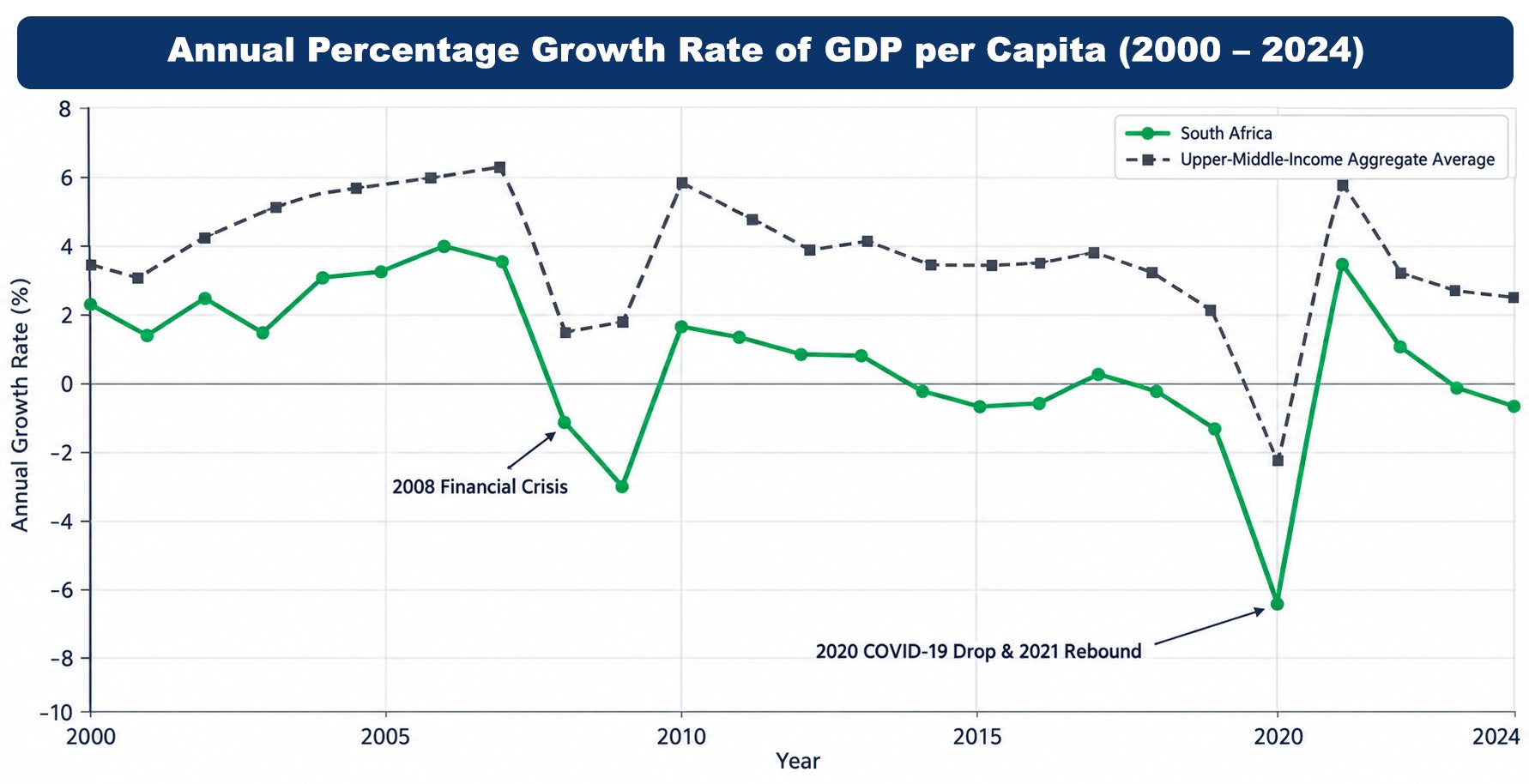
Sources: World Bank National Accounts Data and the OECD National Accounts data via Gemini
- GDP has grown only half as fast as the population, resulting in a significantly lower income per person today, on average, than 2013.
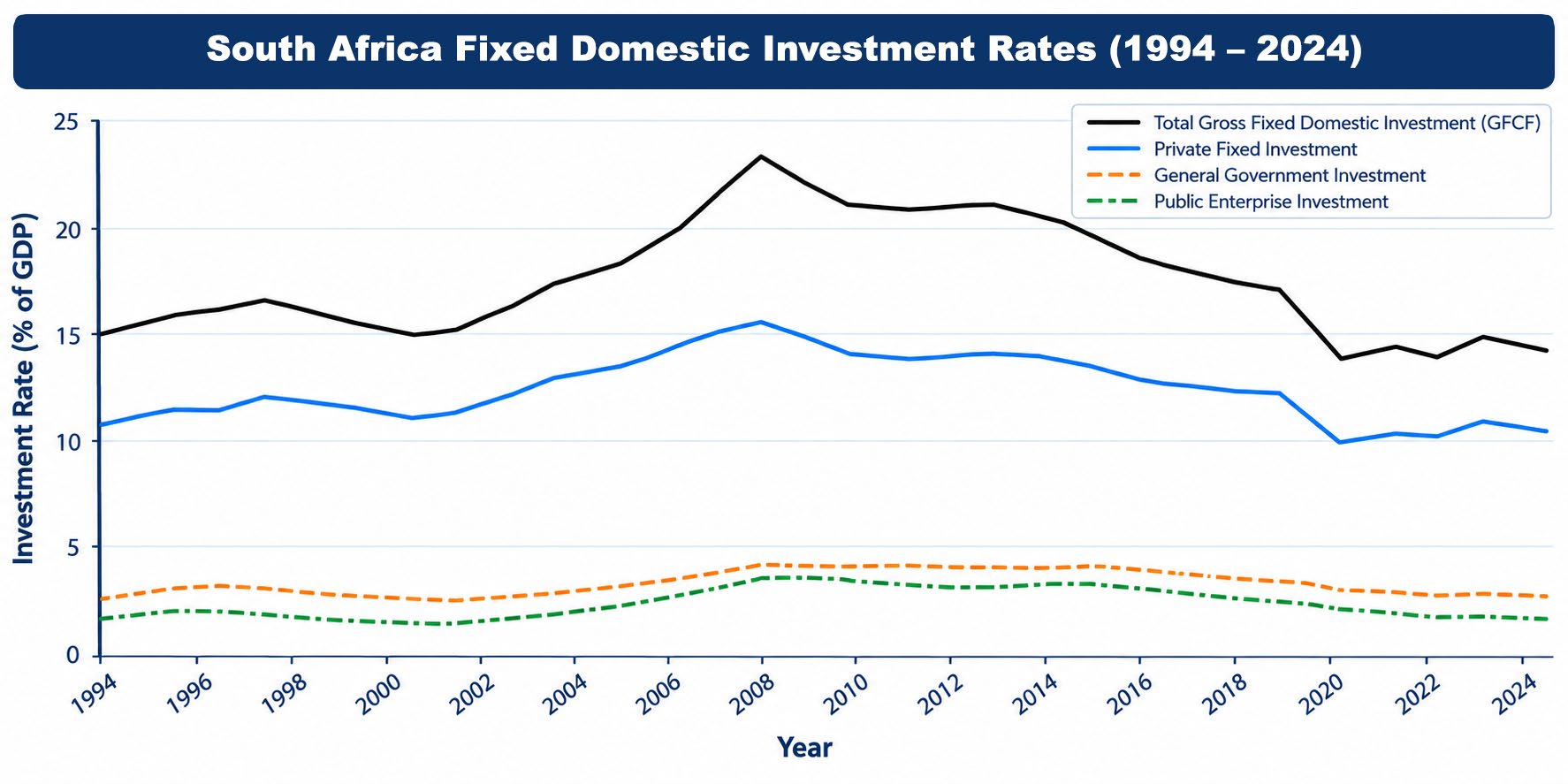
- South Africa’s investment rate is extremely low – gross fixed domestic investment is lower than 15% of GDP, barely replacement rate, and much lower than successful developing economies where investment is 25% and much higher relative to GDP.
Figure 2: Gross fixed domestic investment by the private sector, government and public enterprises
Source: SARB via Gemini
- The investment rate graphic (Figure 2) shows how low private investment has fallen since 2008, but also that government and public enterprise investment have also fallen to the lowest levels since 1994.
- Poor investment levels lead to low growth, higher unemployment and poverty – Figure 3 shows that when the economy grows reasonably quickly employment follows. Employment growth lags economic growth because confidence builds slowly.
Figure 3: Change in real GDP and total employment: Year on year percentage change
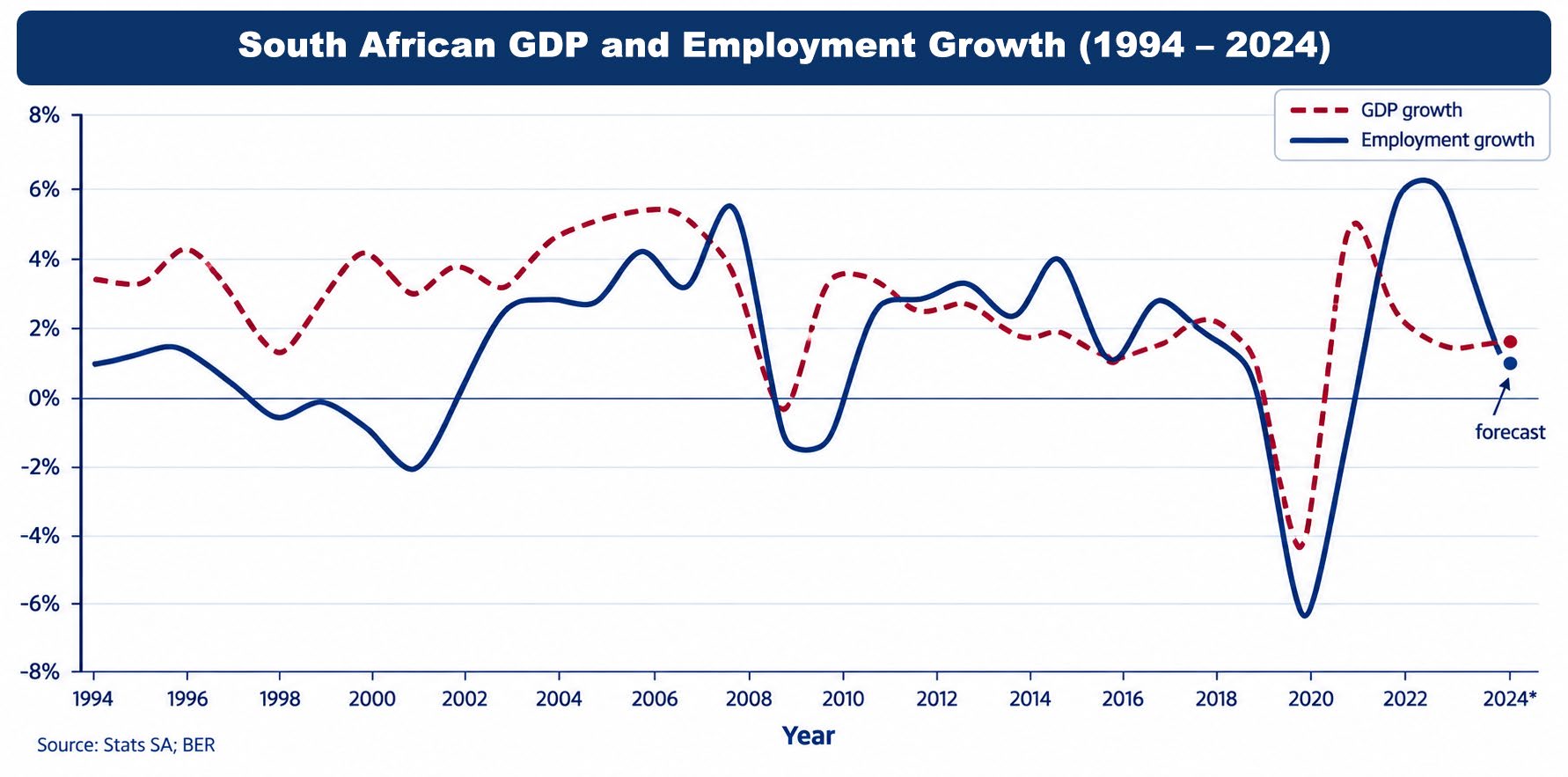
Sources: StatSA and BER via Gemini (note the anomalies of the Covid period 2020–2022)
Could we return to the performance of the 2004–2008 period?
Figure 3 shows that when the economy grew quite rapidly between 2004 and 2008, employment grew much faster too. The rate of unemployment fell sharply to about 22%. Econometric studies estimate that in middle-income countries 6% growth results in roughly a 4% expansion of employment. South Africa’s ratio is similar. Accelerated growth is thus part (though, as we argue in our other posts in this series, only part) of what is needed to reduce unemployment.
Is it possible to reproduce the conditions that produced rapid growth? To answer this question, we need to think about what the major factors behind the successes of that time were.
Firstly, investors were increasingly confident about economic management in South Africa. Financial governance was conservative under Mbeki and Manuel: debt was hugely reduced and tax collection was improving fast too, even at lower tax rates. Monetary policy was disciplined and financial sector regulation had improved.
Government delivered on commitments to build infrastructure in turn encouraging private investment, with private investment contributing most of the increase in fixed investment (shown in Figure 2).
Political and business leaders sought closer cooperation in a range of structures. Government-business cooperation included initiatives to reduce the crime rate which were quite successful.
Secondly, China’s massive and unprecedented infrastructure boom resulted in a global super-cycle driving up the global prices of commodities, many of which South Africa produced.
And thirdly, a delay in tightening new South African consumer protection laws inadvertently led to a massive increase in consumption lending which artificially boosted the growth cycle even further in its final years.
When the crash came towards the end of 2008, South Africa was hit with both the developing world-style trade crisis as demand for commodities plummeted, and a first world-style credit crunch as banks turned sharply conservative on lending.
The second and third conditions (commodity super-cycle and credit explosion) that accelerated the growth boom were unique and are not reproduceable. The first condition, building confidence in the economic management of government is possible. That confidence has risen since the end of the Zuma presidency during which finance ministers were often sacked, and the tax authority was badly undermined. The current rate of investment illustrates, though, that confidence is still far from the level it reached in the decade of the 2000s
Progress on some of the priorities of Operation Vulindlela (like stopping electricity ‘loadshedding’ and improvements in visa management for skilled employees) has contributed to rising confidence in government. However, the inability of government to implement many other policies effectively, the failure to reduce crime, the absence of fixed investment by many government institutions and state-owned enterprises, and the general absence of visible coordination in government all detract from recent gains.
Challenges and possibilities
As we pointed out in the first article, the most important economic reforms so far have been those driven by Operation Vulindlela, or OV, in the Presidency. OV is a joint programme with resources provided for design and implementation by government in a very active and innovative business partnership with leaders in business. The first two phases of OV focused on stabilisation. The first, reforming the electricity, freight transport and water and sanitation sectors, and visa reform for business migrants have all, with the exception of municipal water and sanitation provision, made good or reasonable progress. Further investment by the state and its agencies in economic and social infrastructure can support more investment and job creation, as well as greater welfare.
The second phase reforms further advance the priorities for Phase 1 and add spatial restructuring of cities and housing, digital public infrastructure and local government reform. The latter have made little progress so far.
Government agreed to move ahead with Phase 3 of the Government-Business Partnership well before the completion of Phase 2 of Operation Vulindlela. The welcome new focus is economic growth and job creation.
In addition to investing in core physical and digital services and combating crime and corruption, Phase 3 wants to drive private investment in growth and job creating sectors of the economy. Three broad sectors are identified: the mining sector, agriculture and agro-processing and tourism.
The mining sector, which currently employs about 470 000 people directly has been poorly regulated for many years and dysfunctionality in the government’s cadastral system has held back exploration and investment. Fixing these deficiencies and ensuring a strong partnership between government and business could elicit R50 billion in capital expenditure by 2028. A growing mining sector could have numerous positive spinoffs for the economy and society.
Improvements in the agriculture value chain could create as many as 100 000 new jobs within a year according to Phase 3 plan. Interventions include strengthening the Port of Cape Town’s cargo handling facilities, opening priority export markets and granting title deeds to new farmers who have benefited from land reform. The plan also targets two or three new import substitution opportunities in the agricultural sector.
The third sector is tourism, a sector that contributes significantly directly and indirectly to job creation. With more flights, completion of the Electronic Travel Authorisation (ETA) system, and through more targeted marketing, the plan hopes to raise tourist arrivals.
Notably, the partnership won’t focus on broad manufacturing for now – a sector which has been haemorrhaging jobs in South Africa. As Rodrik noted, the path to prosperity for developing countries through manufacturing is now largely monopolised by East Asian countries, led by China where manufactures are also losing their employment absorptive capacity due to robotisation and other forms of automation.
Some manufactures may well grow, in a wide range of sectors, mainly to supply domestic and regional markets, but manufacturing industry is unlikely to make the major contribution to growth and employment.
What about services?
As we noted in the beginning of this blog, improvements in the productivity of services sector was highlighted by Rodrik as likely to become increasingly important in fostering growth. While the sectoral strategy of Phase 3 narrowly targets tourism in the services sector, digitally delivered services have also grown rapidly and now account for a significant share of South Africa’s export earnings. This is despite South Africa’s regulatory environment for digital trade being restrictive compared to peers, limiting potential in services exports. Lawrence Edwards argues that trade agreements should include services and digital trade provisions, and South Africa should participate in global e-commerce negotiations.
However, non-tradeable services can also contribute to job creation and growth. Some traditionally non-traded services such as health, education and care of the aged could also play a far greater role in investment and job creation for the domestic market and for visitors, greater possibly than conventional service exports.
One of the virtues in the approach of Phase 3 is that it remains relatively narrowly focused, avoiding the dissipation of government’s energy and attention. Another is that it is built on partnership – partnership between government and business, a critical ingredient of developmentalism which the ANC expunged from its vision of a developmental state at its Polokwane Conference in 2007.
Recently, the Department of Trade, Industry, and Competition (DTIC) launched the Industrial Development Strategy 2026. The sectors identified are multiple and varied, including defensive plays in some manufacturing sectors and forward-looking sectors like global business services. There is no reference to any kind of partnership with the business community in the implementation strategy. it is very hard to see how the IDS aligns with Phase 3.
Neither of these growth strategies engage with the role of the smaller businesses and the informal sector in growth and employment creation. Nor do we in this article. But in later articles we will address the importance of these sectors for job creation and growth, as well as the opportunity to bridge the dual economy divide.
Summing up
While stimulating growth is not a sufficient strategy for job creation, it is essential. South Africa has opportunities to drive the economy forward relying on better government services and infrastructure and well-developed partnerships.
Growth will come from unblocking the obstacles to the rapid expansion of the mining sector and the agricultural value chain and in exploiting opportunities in the services sector, including traditionally tradeable services and those considered non-tradeable. Sustaining growth will entail deeper investment in economic and social infrastructure. Alongside these growth sectors, manufacturing will grow too, significantly affecting some regions and communities.
The recent example of the Industrial Development Strategy 2026 emerging confusingly alongside Phase 3 of the Government Business Partnership underlines the necessity to organise government better so that its limited resources can be effectively focused on real opportunities for rapid growth. While OV phases 1 and 2 lay the foundations for a sustained burst of economic growth and job creation, better coordination within government and strong relationships with business, unions and other civil society partners must form the basis of an effective growth and employment strategy.
Alongside effective coordination and partnership within government and between government and key stakeholders to accelerate growth, there must also be reforms that engender confidence in the broader South African society that the crises in jobs and living standards among the poor are being addressed effectively. While reforms must include better housing strategies and the reduction of crime levels, our focus is on those reforms which support the informal sector and small enterprises with the potential to grow and expand employment at scale, and which thus are critical to overall success. These are the subjects of the next two articles in this series.