Technical Annex B: Employment impact of the connectiveinterface
By Brian Levy and Alan Hirsch
This technical annex lays out the quantitative assumptions underlying the scenarios presented in Table 1 in the main text of the “overcoming dualism – the connective revolution” blog. While the assumptions are intended to be broadly plausible, we make no claim that they are empirically precise. Rather the aim is to underpin a series of heuristic thought experiments – the intent is to clarify, for a variety of scenarios, the mechanisms at work and the resulting orders of magnitude of changes in employment over 10 years for each of formal, informal and connective middle firms.
As the main blog details, the focus is on a subset of the broader connective revolution – namely, the variety of ways in which it creates new job opportunities for township enterprises, including via its impact at the interface between South Africa’s township and formal economies. These effects play out across multiple channels, so their magnitude can be difficult to pin down. Table 1 in the main text cuts through this complexity by characterising the ‘connective middle’ as a distinct sector. As laid out in the technical annex that accompanies the “jobs and the informal sector” blog post, “connective middle” firms are assumed to have an intermediate level of labour productivity – higher (and thus less labour-demanding) than survivalist firms, and lower (and thus more labour-demanding) than firms in the formal sector.
Annex Table B1 provides an overview of the empirical approach, and some of its core assumptions. The rows in the table distinguish between employment impacts that come via connective firm expansion into formal, higher-income markets and via expansion within the township economy. As the columns signal,
both the rate at which connective firms expand, and the sources of that expansion vary across the two submarkets. (Note: what follows takes as its contextual point of departure the third scenario laid out in the earlier ‘Jobs and the informal sector’ blog post – 4% average annual formal sector growth, and reforms that improve the economic environment for the informal sector.)
Annex Table B1: Assumptions underlying estimates of the ten-year employment impact of the ‘connective revolution at the interface’
(4% average annual growth and a newly liberalised environment for the informal sector)
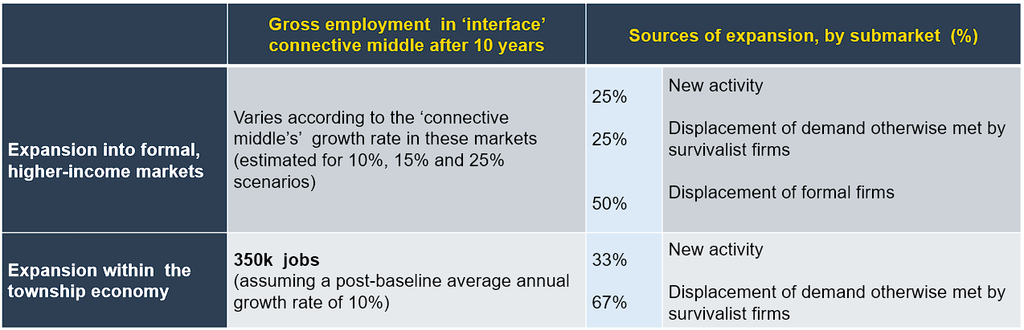
Consider first the rate of expansion. Conceptually, it can be expected to follow the classic multi-phase innovation pathway – exogenous innovation, early adoption, acceleration and maturation, with the rates of expansion varying across the two sub-markets. To avoid the complexity of specifying growth rates for each sub-phase, 10-year estimates of gross connective-middle employment expansion are derived using the following assumptions:
1.Very rapid early emergence and take-off in each of the higher-income and township economies. The model’s baseline assumption is that after 18 months there are roughly 150 000 connected middle jobs in each of the two submarkets. (In practice, in the spirit of plausibility, this baseline also signals the reality that the connective revolution is already beginning to take hold; the ‘day one’ point of departure is therefore not zero.)
2.Subsequently, over the remaining 8½ years of the 10-year period, reflecting the much larger market and growth opportunities in the higher-income market, growth rates are assumed to diverge across the two submarkets:
–For expansion into the township economy, the model assumes an average annual growth rate of 10% (which, combined with the 150k point of departure, yields a 10-year total of roughly 350k ‘connective middle’ jobs).
–For expansion into higher income markets, along with a baseline 10% scenario, two more rapid growth scenarios also are considered -15% and 25% after the initial 18 months. These yield 10-year submarket totals of roughly 350k, 500k and 1 million jobs.
(Some readers might view 25% average annual growth in the higher-income submarket as implausibly aspirational; but, given the assumed points of departure of a recently reformed economic environment for the informal sector, of 4% formal sector growth – and the innovative character and ubiquitous range of applications for ICT/AI technology – others might argue that an even higher growth rate could be plausible.) Turning to Annex Table B1’s second column, as it signals (and as discussed in the main text) the principal competitive advantage for connective firms at the interface is not that they introduce wholly new products into the marketplace – though there is some of this – but that the embrace of ICT reduces the transactions (and other) costs of doing business. As per the table:
–The share of “new activity” is presumed to be somewhat higher in township than higher income markets (33% versus 25%) in part because, within these low-income portions of the economy, aproliferation of new higher-quality and lower cost goods and services can have a positive impact on income, and thus demand.
–Along with new activity, employment gains for connective middle firms are the result of transactions and other cost advantages which enable them to outcompete and ‘displace’ both survivalist and formal firms, with displacement patterns varying in the higher-income and township markets. (Note that, given our starting assumptions of 4% formal sector growth and a newly improved economic environment for informal firms, much of the “displacement” takes the form of a lower rate of expansion than would otherwise have occurred.).
As laid out in Technical Annex A, relative labor productivity across formal, connective-middle and survivalist firms is assumed to be in a ratio of 3:2:1 – a connective-middle job that displaces formal activity corresponds to two-thirds of a formal job; one that displaces survivalist activity corresponds to two survivalist jobs. Taken together, the estimates in the second column of Annex Table B1 and these labour productivity differences provide a basis for estimating the job losses (relative to the counterfactual) shown in main Table 1 for each of formal and township enterprises.