Retiring the 1994 Generation: The Senior Management Service
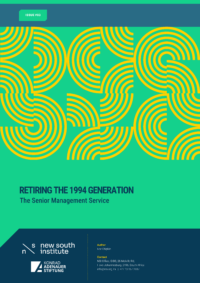
The New South Institute has published the third report in its Government in Numbers series, Retiring the 1994 Generation: The Senior Management Service. Written by Ivor Chipkin and produced with the support of the Konrad-Adenauer-Stiftung (KAS), the report examines the generational transition taking place at the senior levels of South Africa’s public service.
Drawing on PERSAL data from 2009 to 2024, the report analyses the demographic profile of the Senior Management Service, or SMS, across the national public service and within the health and education sectors.
The findings indicate that the generational challenge identified elsewhere in the public service is particularly advanced among senior managers. Across the three sectors examined, the average age of SMS members is between 53 and 55. Officials aged 50 and older account for approximately 73 to 80 per cent of senior managers, while those younger than 40 make up between 2.1 and 2.7 per cent.
The report describes the SMS as a largely closed cohort that has aged without sufficient entry by younger officials. The generation that entered or developed its public-service careers during the transition after 1994 now occupies much of the management apex of the state. Many of these officials are approaching retirement, but the available data show that there is no comparably sized generation being prepared to succeed them.
This creates a significant institutional risk. When senior managers leave, departments may lose accumulated knowledge, specialist expertise and long-standing organisational relationships. Unlike some entry-level vacancies, senior management positions cannot be filled effectively without experienced and properly prepared candidates.
The challenge is especially pronounced in education, where 80.2 per cent of SMS officials were older than 50 in 2024 and the mean age was 55. In health, 71.4 per cent of senior managers were older than 50, while the size of the health SMS had declined substantially since 2009. The report argues that the ageing of senior managers compounds the workforce pressures already affecting teachers, nurses and other frontline public servants.
Building on the Government in Numbers series
This report develops the analysis presented in the first two publications in the series.
The first report, Retiring The 1994 Generation of Public Servants: From a Party-State Public Service to one ready for Multi-party Democracy, documented the ageing of the police, health and education workforces. It argued that the generation that built South Africa’s post-apartheid public administration was beginning to retire without an adequately prepared generation to replace it.
The second report, Talent Management in the South African Public Service: Evidence from Provincial Departments of Health, examined the ability of provincial health departments to attract, develop and retain essential skills. It identified weak succession planning, declining numbers of professional nurses and the need for more deliberate workforce planning.
The third report moves the analysis to the leadership of the public service. It asks who will manage departments, oversee public resources, lead institutional reform and implement the Public Service Amendment Act as the current senior cohort retires.
A risk and an opportunity
The retirement of the 1994 generation presents a serious risk to state capability if it is not managed. It also provides an opportunity to renew the public service.
The report argues that the recruitment of a new generation of senior managers should be based on transparent competition, professional merit, constitutional accountability and the requirements of a multi-party democracy. This would help move the public service beyond recruitment and advancement practices shaped by party-state relationships.
Among its proposals, the report calls for urgent modelling of expected SMS retirements across departments and sectors. It also recommends establishing a national public management development programme through which younger professionals could receive structured training, departmental experience and mentorship from outgoing senior officials.
Preparing this successor generation will require action before the largest wave of retirements begins.
.