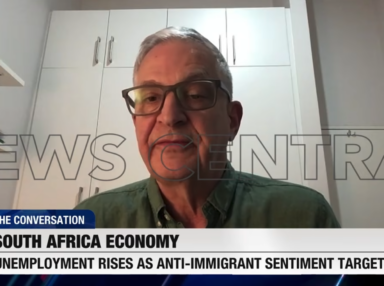
Alan Hirsch writes in the Sunday Times on anti-immigrant violence in South Africa
On 24 May 2026, Alan Hirsch, Head of Migration Governance Reform Programme at the New South Institute, published an opinion piece in the Sunday Times titled “Time to take a stand against anti-immigrant violence.”
The article responds to the renewed wave of anti-immigrant mobilisation and violence in South Africa, placing it in the broader context of almost two decades of recurring hostility towards foreign nationals. Hirsch argues that South Africa cannot treat these episodes as isolated or spontaneous. Instead, the country needs a more systematic response to both the violence itself and the deeper social and political conditions that allow it to spread.
Among the article’s main arguments, Hirsch notes that immigrants make up a relatively small share of South Africa’s population, and that most are legally present in the country. He argues that pressure on jobs, housing and public services is driven less by migration itself than by South Africa’s broader economic difficulties, high unemployment, poverty and weak public service delivery. At the same time, he recognises that perceptions matter, especially in poor communities where citizens and migrants live side by side under difficult conditions.
Hirsch also warns against political actors who exploit public frustration by blaming migrants for problems rooted in state failure and economic stagnation. He calls for firmer leadership against prejudice, stronger action against intimidation and violence, continued efforts to improve the integrity of border management, and a more deliberate approach to integration and social cohesion.
Readers are encouraged to read the original article on the Sunday Times website. For convenience, the full text is also reproduced below.
________________________________________________________________________________________________
ALAN HIRSCH | Time to take a stand against anti-immigrant violence
.
Anti-foreigner anger and violence have intermittently plagued South Africa for nearly 20 years, but few are asking how we can fix it.
How can we lower the temperature and avoid destructive anger and violence?
Immigrants in South Africa number about 4-million, and most are legal. This is 6% of the population, compared with, say, Australia and Canada at more than 20% and the US and many European countries at 10%-20%. The US has about 46-million foreign-born residents.
So it is unlikely that pressure from undocumented immigrants on jobs and public services would be a burden on South Africans if jobs and houses were not so scarce and public services were not as deficient as they are.
But that doesn’t change perceptions — especially of those impoverished people living cheek by jowl with undocumented migrants. And it doesn’t stop those who mobilise anti-foreigner sentiment for their own political purposes. Opponents attack the government for lax border management, and the government often blames immigrants when hospitals and schools cannot provide adequate services because of government mismanagement.
Anti-foreigner sentiment first boiled over in 2008. This was the year South Africa accepted, under temporary permits, many Zimbabweans fleeing an economic collapse in their country. Similar permits had previously been issued to citizens of Angola and Lesotho.
With nearly 40% of our population living in poverty and 32.7% unemployed, it is not surprising that a spark can easily light a fire of anger.
South Africa’s refugee policy, finalised in 1998, is humane. Beyond the Refugee Act, undocumented migrants may apply for asylum and jobs.
Unlike many other African countries, South Africa does not put asylum seekers in camps — they prefer to live in urban communities where there are job opportunities. South Africa’s approach to this issue was widely praised as humane, but it often means needy immigrants live alongside poor South Africans who do not have decent work themselves and who are also subject to poor public services. With nearly 40% of our population living in poverty and 32.7% unemployed, it is not surprising that a spark can easily light a fire of anger.
The Institute for Security Studies says that while some older and poorly educated South Africans have prejudices against immigrants, younger and better educated South Africans may resent what they see as unfair competition, but they don’t exhibit xenophobia as such. The Human Sciences Research Council has detected a growing antagonism towards immigrants over the past five years among poorer and working-class South Africans. It attributes this to frustration with the country’s poor economic performance since the Covid crisis and rising crime rates.
The UN secretary-general, Amnesty International and several foreign governments, including those of Mozambique, Nigeria and Ghana, have taken South Africa to task for not responding appropriately to anti-migrant mobilisation. In its response to Ghana’s proposal to take the issue to the AU for debate, the South African government said the violence was sporadic and that appropriate action was taken. It also called for solidarity from South Africans with other Africans, many of whose countries had supported the struggle for freedom. President Cyril Ramaphosa also called out those who were fomenting anger.
But there has been no systematic response. This is a matter of extreme embarrassment and, indeed, shame.
What might a systematic response be?
Unlike many countries with relatively high immigration, South Africa has no co-ordinated effort to integrate foreigners or help citizens to understand, accept and even welcome foreign migrants. For example, many European countries and cities have programmes to encourage integration and cultural understanding between immigrants and locals.
I was in the UK shortly after Russia’s invasion of Ukraine and was struck by how local governments and religious communities gave moral and material assistance to Ukrainian refugees. Some church leaders have reached out to refugees at critical times in South Africa, but these are exceptions.
Why have we not yet seen more action taken in response to mobilisation against foreigners? In some cases, legal action might be warranted; in others, speaking out firmly against prejudice should be expected from political leaders. Yet some continue to exploit the anxieties of South Africans for electoral purposes.
South Africans are vulnerable to the exaggerations and lies about foreigners because they have lost trust in the government to protect them, provide services and maintain an economic climate that creates jobs. While the establishment of a forceful Border Management Agency and the series of firings and prosecutions of corrupt officials in the permit section of the department of home affairs are welcome, efforts to ensure the integrity of our borders must continue.
The department of employment & labour has proposed minimum quotas for South Africans in various sectors. Such an initiative could assure South Africans that jobs are allocated to them, while preventing unfairness to immigrants and employers.
To our shame, South Africans have practised violent and discriminatory behaviour towards immigrants for 18 years. If we do not confront the haters and the underlying causes, we risk even greater dehumanisation of our African neighbours.