Alan Hirsch on migration, governance and leadership in South Africa
At a panel discussion hosted by the Nelson Mandela School of Public Governance, Alan Hirsch examined the evidence behind perceptions of a migration crisis and the government’s response to recent anti-foreigner mobilisation.
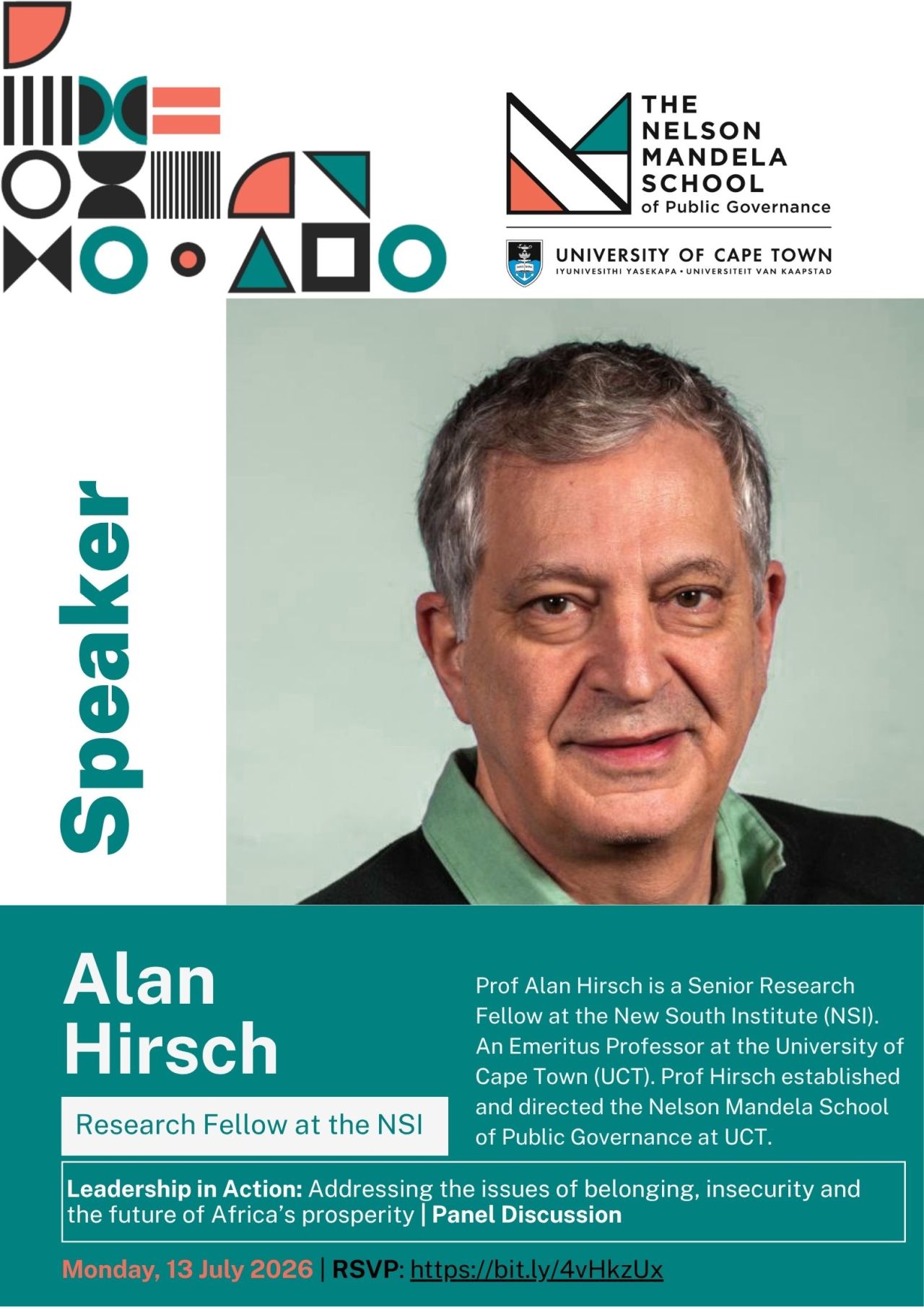
On 13 July 2026, Alan Hirsch, Head of the New South Institute’s Migration Governance Reform in Africa Programme (MIGRA), participated in the Leadership in Action panel discussion, Addressing the Issues of Belonging, Insecurity and the Future of Africa’s Prosperity. The event was hosted by the Nelson Mandela School of Public Governance at the University of Cape Town.
Hirsch argued that South Africa’s recent anti-migrant mobilisation should be understood primarily as a crisis of governance and leadership rather than as evidence of an exceptional increase in migration. Available estimates place the country’s migrant population at approximately 4% to 6% of the total population. The data presented by Hirsch also indicates that the number of migrants living in South Africa has not increased significantly since 2015.
He located growing hostility towards migrants within a wider context of prolonged low economic growth, unemployment, inequality, rising living costs and weaknesses in public administration. In this environment, migrants are frequently blamed for pressure on employment and public services, even where the available evidence does not support these claims. Hirsch also drew attention to the role of organised political mobilisation and misinformation in intensifying public anxiety.
The presentation examined the government’s response to threats and violence directed at foreign nationals. Hirsch argued that the response was delayed and often ambiguous, combining calls for public order with language that appeared to validate some of the assumptions promoted by anti-foreigner movements.
He contrasted this approach with South Africa’s rapid mobilisation during the COVID-19 pandemic and with the United Kingdom government’s response to anti-Muslim riots in 2024. These examples, he suggested, demonstrate the importance of intervening early, communicating consistently, coordinating across institutions and acting against those responsible for incitement and violence.
Hirsch proposed that an effective response would require cooperation between national, provincial and local government, as well as engagement with civil society, businesses, trade unions and community organisations. He also highlighted the need for stronger regional cooperation on economic development and labour mobility, alongside credible implementation of immigration policy and enforcement of the rule of law.
These issues are central to NSI’s Migration Governance Reform in Africa Programme. Led by Hirsch, MIGRA studies the relationship between migration, development and regional integration, with a focus on practical reforms that can make mobility across African borders more regular, predictable and effectively governed. Its research has examined migration policy and implementation in South Africa, national and regional systems elsewhere on the continent, and the role of African regional and continental institutions.
The discussion was moderated by Professor Cheryl Hendricks and included Nomathamsanqa Masiko-Mpaka of Human Rights Watch South Africa, Mark Heywood, Mpule Kgetsi and Basetsane Mosia. The panellists addressed questions of human rights, economic exclusion, youth leadership, belonging and social cohesion across Africa.
Hirsch subsequently developed the central arguments from his presentation in an opinion article for GroundUp, titled “Xenophobia: what the government should have done — and can still do.” The article considers how earlier intervention, clearer political leadership and stronger coordination could have limited the escalation of violence, while identifying measures that remain available to the government.
.