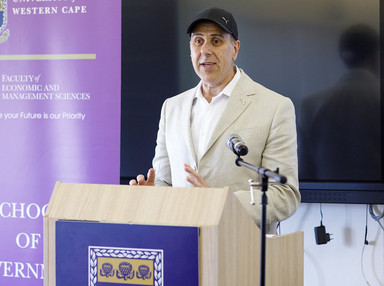
Ivor Chipkin publishes op-ed in News24 on the approval of the Public Service Amendment Bill
The Public Service Amendment Bill removes a major source of power from government ministers and MECs. Parties in the Government of National Unity now share the same concerns that the African National Congress had in 1994. They are inheriting officials, appointed by ANC ministers or through ANC-controlled processes, whom they do not trust. Why should they be stuck with them?
Yet, the solution is not to politicise the South African public service anew. In this new era of weak majorities and unstable coalitions, political control of the administration is a recipe for chaos.
In this article published by News24, NSI’s Ivor Chipkin argues that the problem is, in part, being resolved as the current generation of public servants retires. He also proposes that we urgently implement the Professionalisation Framework.
History has come round again. Let us seize the day
Ivor Chipkin, New South Institute
Originally published in News24 on 16 July 2025
As you read this, politicians in South Africa are considering probably the most important legislative reform since 1994.
In February last year, the National Assembly passed an amendment to the Public Service Act of 1994. The amendment is currently under consideration in provincial legislatures before moving to the National Council of Provinces (NCOP) for a vote.
The NCOP was established by Chapter 4 of the Constitution to make sure that provincial interests were taken into account by national legislation. Each province sends 10 delegates, six reflecting the number of seats that political parties hold in each legislature, and another four ‘special delegates’, including the premier (or a representative) and three other experts. In total the NCOP has 90 voting members.
In the voting process, however, delegates vote as a provincial block, whose mandate is determined by the outcome of deliberations in each provincial legislature. Hence, if the KwaZulu-Natal legislature voted yay and the Eastern Cape voted nay, then that is how delegates from these respective provinces must vote in the NCOP. Five of the nine provinces must support a bill for it to pass.
What does the amendment do?
Effectively, it goes far to resolve a contradiction in government that has been a source of decades-long conflict and tension. The South African system of public administration is a hybrid one, intended to reconcile two imperatives, one political and the other, institutional.
On the political front, the ANC inherited a public service in 1994 that it did not trust to implement its policies. Worse, Thabo Mbeki worried that some civil servants were plotting counter-revolution. Yet, the sunset clauses negotiated during the transition protected civil servants’ jobs. If the ANC could not fire apartheid-era officials, the party wanted control over the appointment process for new ones. It also wanted control over what they did.
One of the first pieces of legislation passed by South Africa’s newly elected national assembly was the Public Service Act in 1994. In Section 3, the law granted the power to appoint public servants to what it called the Executive Authority, meaning the president, a minister in national government or an MEC in provincial government. The executive authority was also given power over operational decisions in departments.
Such political control, however, ran up against the new spirit of managerialism in South Africa and elsewhere in the world. The idea behind public management was a simple one. Inefficiency and wastage in government arose because public servants acted as bureaucrats – officials that followed and implemented rules; even when they led to failure or, worse, monstrous and immoral acts. What was needed were managers like those in the private sector – innovative thinkers, freed from red tape, who could design solutions best adapted to context. This new managerial spirit was at the core of much new legislation, especially the Public Finance Management Act.
Yet political control of appointments and operational decisions clashed with the idea of managerial autonomy and discretion. The National Development Plan euphemistically described tensions in the ‘political-administrative interface’. It referred to tense and increasingly conflictual relations between ministers and senior officials, especially directors-general, over who could do what. If a minister refused to delegate administrative powers to a director-general or a head of department, they went to work, essentially, to twiddle their thumbs.
This situation has acted as a heavy brake on the work of government departments for more than 30 years. The Public Service Amendment Bill promises to release that brake, giving heads of departments and senior officials the control and traction they need to move forward. It won’t fix everything overnight – it’s not a magic lever – but it could finally put the public service back in gear.
Why would you not support this reform?
For political parties, especially those in government, including in the Government of National Unity, the amendment would remove a major source of power from their ministers and MECs. They would no longer be able to appoint and control departmental officials in the way that they used to. Many are now concerned with precisely what the ANC worried about in 1994. They will be inheriting officials, appointed by ANC ministers or through ANC-controlled processes, whom they do not trust. Why should they be stuck with them? We are back full circle.
Yet the solution is not to politicise the South African public service anew. In the new era of weak majorities and unstable coalitions, political control of the administration is a recipe for chaos. Yet what to do with existing officials is a problem.
The difficulty is already being solved in practice, though it has not been taken into account by policymakers. New work by the New South Institute, based on analysis of the government’s human resources data, shows unmistakably that the first generation of post-apartheid public servants is reaching retirement age. In the SAPS, for example, the number of police in the age cohort 51 to 65 has grown from around 14,000 in 2009 to around 46,000 in 2023, a spectacular rise of 225%. Similar dynamics are playing themselves out amongst nurses and teachers as well. In other words, the old is retiring and the new has not yet been appointed.
For some time now, the South African government has been discussing a professionalisation framework to train officials for public service, who have been appointed on strictly meritocratic criteria. A minimum entry exam for public servants, like that which exists in most high-performing countries in the world, has been mooted. This is now the time to fast-track these proposals, focusing on bringing young people into government administrations. Over the next decade, they will become the senior officials with the right ethos and experience to run departments effectively.
If our elected leaders can lift their gaze beyond the politics of the moment and recognise the profound opportunity before us, they will champion the Public Service Amendment Bill and push for the implementation of the professionalisation framework. South Africa stands once again at a crossroads – a moment rich with the possibility of renewal. History is offering us a rare second chance to build a capable and professional state. We must seize the day.