Jelena Vidojević and Mandira Bagwandeen publish op-ed in News24 on South Africa’s foreign policy dilemma
Editor’s Note: This article was originally published by News24 on 4 March 2026 and can be accessed here. It was written by Jelena Vidojević, Co-Founder of the New South Institute and Head of its South-South Dialogues Programme, and Mandira Bagwandeen, Affiliate Researcher in the South-South Dialogues Programme. For the convenience of our readers, it is reproduced here in full.
______________________________________________________________________
South Africa is facing a pivotal moment. With intense competition between the United States (and parts of Europe) on the one side, and China and Russia on the other, Pretoria’s declared policy of “active non-alignment” is being tested, and often found wanting, especially by Washington and several European governments.
One cannot help but ask whether South Africa’s invocation of active non-alignment, with its obvious appeal to the Cold War heyday of the Non-Aligned Movement, reflects a misreading of the current geopolitical moment, or even a failure to critically and substantively define the concept in ways that capture and address today’s diplomatic challenges.
While the concept of non-alignment has been part of the country’s democratic identity since 1994, the addition of the “active” modifier was intended to emphasise its proactive character. Prior to this, it had not been identified or defined as a guiding principle in strategic foreign policy documents or communications, the most important of which was the Framework Document on South Africa’s National Interest, issued in August 2022.
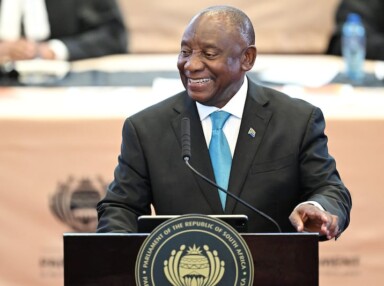
In August 2023, in a televised address to the nation ahead of the 15th BRICS Summit, President Cyril Ramaphosa affirmed South Africa’s commitment to active non-alignment. He defined it as a refusal to be drawn into “a contest between global powers”, while proactively seeking partnerships that advance South Africa’s national interests. Under the Government of National Unity (GNU), the term has been solidified as official doctrine. In July 2024, the Minister of International Relations and Cooperation, Ronald Lamola, reaffirmed that “South Africa, with its unique policy of active non-alignment, is not reactive but proactive in its pursuit of peace”.
But questions remain. Why should the country be non-aligned rather than aligned? What does non-alignment mean, and how has such a policy been actioned, if at all? Historically, non-alignment referred to a foreign policy position of independence from both the United States and the Soviet Union. Since the collapse of the USSR, what does non-alignment, even “active” non-alignment, refer to? These questions remain unanswered in official South African strategic foreign policy documents, leaving it to Department of International Relations and Cooperation officials and the president to sketch out the policy in their respective speeches.
Alignment with non-Western powers?
What we know is that South Africa’s relationship with the West, most notably the US, has been deteriorating for some time. Since Trump assumed the American presidency for the second time in 2025, the relationship appears to have entered a free fall. Moreover, South Africa’s active non-alignment foreign policy is increasingly perceived, especially in Washington, as de facto alignment with non-Western powers. This perception has been reinforced by actions such as joint naval exercises with Russia, China, and (recently) Iran, and South Africa’s repeated abstentions on UN resolutions condemning the war in Ukraine.
On this issue, South Africa’s position broadly mirrors that of much of the Global South, which has displayed indifference toward the Western stance on Russia. Additionally, Pretoria’s diplomatic activism on the Israel-Palestine conflict, including its application to the International Court of Justice accusing Israel of genocide, has further reinforced this perception.
At the same time, South Africa’s place in a new emerging world order, which is being shaped largely (but not exclusively) by Asian powers, remains uncertain. With the rising prominence of civilisational imaginaries in the intellectual and policy circles of Russia, China, India, and Turkey, one cannot help but worry that a new world order may be typified by a hierarchy among states, categorised between so-called civilisational states and ordinary nation-states. If this is indeed the case, where does that leave South Africa?
SA must redefine its position
The key challenge for Pretoria is not simply to choose more wisely between Washington, Beijing, and Moscow, or between multilateralism and bilateralism. To navigate the current hyper-geopolitical landscape, South Africa must redefine its position, moving beyond perceived vacillation between the West and the East, toward a deliberate and tactful use of strategic ambiguity. This does not imply a foreign policy devoid of principles. On the contrary, it seeks to preserve and assert the country’s sovereignty as a democratic and independent state in a volatile and unpredictable global environment.
The path of strategic ambiguity is challenging and highly demanding. Its success will largely depend on the quality of strategic thinking and the willingness to conduct sober, well-grounded analyses and definitions of national interest, rooted in our historical experience yet oriented toward a forward-looking vision. It also requires discipline, sound diplomatic skills, and resilience under pressure, all of which will depend not only on the experience, competence, and integrity of South Africa’s political elite but also on the institutional structures that provide knowledge, expertise, and the capacity for rapid response.
Essentially, strategic ambiguity is not an excuse for indecision but a deliberate strategy of self-preservation in a world that threatens to swallow the sovereign interests of middle powers. South Africa has the regional standing and economic potential to lend credibility to an ambiguous stance. It can transform its current tightrope walk from a precarious balancing act into a more deliberate and confident strategy. Ultimately, mastering the art of strategic ambiguity — and keeping its geopolitical alignments intentionally flexible — could enable South Africa to safeguard its sovereignty as its most valuable and non-negotiable asset.
Outdated
A rethink of the country’s foreign policy is long overdue. Predominantly shaped by outdated and often messianic aspirations, our current foreign policy approach is ill-equipped to safeguard the nation’s interests in what is increasingly described as a fractured world. Power has become more widely distributed and is, at least for now, less structured.
For a country like South Africa, whose international authority still predominantly stems from its democratic transition and status as a regional (economic) power (despite significant domestic challenges), choosing a side is more than just a diplomatic move; it could have major geopolitical and economic ramifications. It is important to keep in mind that the purpose of foreign policy is to help create (or contribute to) an external environment conducive to domestic development. Foreign policy decisions, especially those concerning alliances, whether formal or informal, have significant implications for trade, investment, and development partnerships that are essential to addressing South Africa’s triple challenges of widespread poverty, high inequality, and significant unemployment.