Alan Hirsch Discusses South Africa’s Migration Policy at SALO Dialogue
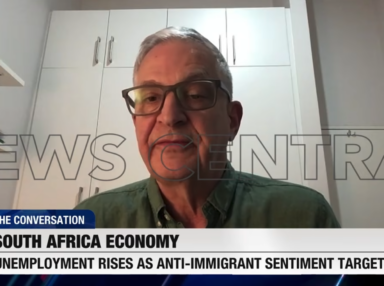
Alan Hirsch, head of the Migration Governance Reform in Africa programme (MIGRA) at the New South Institute (NSI), spoke at a virtual discussion hosted by the Southern African Liaison Office (SALO). SALO is an organisation that shapes discourse on foreign policy, especially in relation to African crises and conflict resolution.
The virtual dialogue focused on recent and proposed changes to South Africa’s migrant policy, with a particular focus on the White Paper on Citizenship, Immigration and Refugee Protection: Towards A Complete Overhaul of the Migration System in South Africa policy paper.
Alan presented findings from the third report in our MIGRA series, South Africa Country Study: Migration Trends, Policy, Implementation, and Outcomes. In it, he offers a critical analysis of the draft White Paper, highlighting its proposals and the political motivations behind them, especially in the run-up to the 2024 elections.
During his presentation, Alan acknowledged notable recent improvements made by the Department of Home Affairs across several important areas. However, he emphasised that much work remains. He noted that the 2023 White Paper, approved by Cabinet in 2024, was drafted under a different administration, in a climate where migration had become a heavily politicised issue during election campaigning.
Alan also pointed out that several valuable elements included in the 2017 White Paper were omitted from the 2023 draft. Looking forward, Alan expressed hope that future iterations of the White Paper would provide greater clarity on refugee status assessments, suggesting that artificial intelligence might help reduce administrative backlogs. He also raised concerns about the processes for awarding citizenship, and how residential status, permanent residency and the rights of long-term undocumented migrants, particularly those under the Zimbabwean Exemption Permit (ZEP) and Lesotho Exemption Permit (LEP), would be addressed.
Alan concluded by stressing the need to return to foundational questions: What are our goals for migration governance? What principles − such as fairness, constitutional values, and Pan-Africanism − should guide our approach? From this foundation, more thoughtful and coherent policy can be built.
The full recording of the dialogue is available on SALO’s Facebook page.