Building Shared Prosperity in South Africa (3/5) – Jobs and the Informal Sector
By Brian Levy and Alan Hirsch
South Africa has a threefold economic challenge: to increase income, to create more jobs, and to strengthen the economy’s largely missing productive middle sector. Economic growth is necessary for all three – and our previous post in this series explored how growth can be accelerated.
This post and the next go further: they argue that effectively addressing all three challenges calls for an expansive approach to growth that goes beyond the usual pre-occupation with the formal economy; the key is to also bring the informal sector to the forefront. This post lays out a bird’s-eye view of the argument. The next post provides a more textured view of the informal economy, with a particular focus on how Information and Communications Technology (ICT)/Artificial Intelligence (AI) affect transactions and other costs at the interface between the formal and informal economies. As that post will argue, the emergence of ICT/AI at that interface has the potential to finally help fill in the missing productive middle that has long been one of the root causes of the toxic dualism that continues to hold South Africa’s economy, politics and society in its thrall.
As laid out in our earlier posts, South Africa’s unemployment rates – 33.6% open unemployment and 43.8% including discouraged workers – are appallingly high, making it (with its Southern African neighbours) an extreme outlier among middle-income countries globally. Failures in the country’s formal economy – rooted in a combination of economic stagnation and an unusually low propensity to translate productive activity into jobs – might seem to provide an obvious (proximate) explanation for the unemployment crisis.
But, as a joint UCT-Harvard team argued in a 2024 working paper, in this instance the seemingly obvious explanation is not the right one:
South Africa’s share of [formal sector] wage employment is consistent with its income per capita… South Africa’s ability to increase employment as a result of GDP growth is more-or-less on par with other [middle income] countries….
For 2019, almost the entire difference between South Africa and its predicted values arises from having more unemployment and less informality… If South Africa’s labour market looked like that of the average [middle-income] country, then its formal, wage employment rate and inactive rate would be little changed, while its rate of informality would be much higher, and its level of unemployment would be much lower.
How underdeveloped is South Africa’s informal sector?
Econometric analysis in the UCT-Harvard study found that the country’s informal sector provides employment for 8 percentage points less of the total adult population – 18% versus 26% – than the equivalent in other middle income countries. According to one estimate, South Africa’s informal sector contributes only 6% to GDP, compared to 45% in India and 20% in Brazil. At a more micro level, 9% more of Mexico’s urban adult population work in just four informal subsectors – informal retail (street vendors and the like), hospitality (including food hawkers and stalls) and transport – than is the case for South Africa.
The UCT-Harvard study’s analysis implicitly points to a seemingly straightforward policy response: prioritise far-reaching improvements in the economic environment for informal enterprises. Reforms of the economic environment for informal enterprises are, to be sure, desirable on both their economic and societal merits. But the journey from here to there will not be straightforward. Informal sector growth depends not only on reforms that ease supply-side constraints, but also on entrepreneurial initiative, and on the demand-side (having vibrant markets to sell into). Further, informal sector expansion will be at least partly at the expense of pre-existing jobs and firms in the formal economy. The journey from South Africa’s current equilibrium to one resembling other middle-income countries can unfold only over the medium-term and will be politically fraught.
What, then, is to be done?
We lay out our argument in three steps. First, unbundle the encompassing notion of ‘informality’, and identify its component parts. Second, provide some detail on how and why the economic environment within which South Africa’s informal sector operates has led to such dismal performance, and how it might be reformed. Building on these first two parts, we use a heuristic quantitative framework – a combination of real-world evidence and educated guesses – to analyze the aggregate employment impact of three scenarios of informal sector reform. Comparison of the scenarios yields a clear conclusion; liberalisation of the economic environment for the informal sector can be central to addressing South Africa’s unemployment crisis, but only if it is undertaken as part of a broader effort to accelerate economic growth and job creation. But this is getting ahead of things.
The first step calls for clarifying definitions. Except in the narrowest sense of referring to firms that operate outside the formal, registered legal system, informality is a frustratingly vague concept. Greater precision requires drilling down further:
- By geography: The distinctively South African term ‘township enterprise’ defines enterprises according to the specific place where they do business. The notion of ‘township’ dates back to dormitory settlements in the apartheid years but is used more broadly by Ivan Turok and others to encompass settlements that post-date apartheid but resemble the apartheid-era settlements. Many informal enterprises operate entirely outside townships.
- By size: Many (but not all) self-employment, microenterprise initiatives are also informal, as are some small and a few (not necessarily only criminal) medium- or large-sized firms.
- By earnings and entrepreneurial ambition: Informality encompasses a wide range. At one end of the spectrum are survivalist one-person initiatives: people doing what they can, wherever they can, to earn some modest amount, and keep their heads above water financially. (This ‘survivalist’ subgroup comprises the vast majority of what is usually meant by the term ‘informal sector’.) At the other end of the spectrum are vibrant entrepreneurial initiatives, with the latter including (as J.J. Alcock has documented vividly in his 2015, 2018 and 2025 books) highly entrepreneurial township enterprises that operate at quite a large scale.
How big are the various subcategories?
One analysis pegs about three-quarters of those classified as ‘informal’ as survivalist enterprises; growth-oriented microenterprises make up the remaining quarter. Within the township economy, over half of township enterprises are in the informal retail trade (street traders, spaza shops and shebeens) and about one-third in services (hair services, repair, early childhood education).
The emphasis of this blog post is on the aggregate impact of an unleashed informal sector on jobs and poverty – in the short-to-medium term this mostly encompasses the survivalist, microenterprise and township end of the spectrum. The next blog post explores in depth some ways in which the entrepreneurial end of the spectrum could become a powerful vehicle for transformation.
Step two concerns the economic environment within which informal enterprises operate. The root cause of the massive underdevelopment of South Africa’s informal sector relative to other middle-income countries can be traced back to the country’s apartheid legacy, and the resulting patterns of spatial exclusion that characterise South Africa’s major cities. Apartheid-era townships were established at a distance from the economic centre of cities, and intended to serve as dormitory settlements for labour, with very limited economic activity. Spatial inequality was reinforced by massive low-income housing development in the immediate aftermath of apartheid. Apartheid’s legacy also persists indirectly in the rigid, exclusionary regulatory and zoning regimes that are pervasive across the country’s urban areas.
While the spatial legacy can be transformed only over the longer term, policy analyses identify many reform entry points where rapid improvement in the economic environment for the informal sector is possible (see here and here).
These include:
- Improving the frequency and reliability of urban transportation and lowering its cost to users. (In recent years, urban transport reform efforts repeatedly have bogged down in a variety of political struggles.);
- Streamlining the regulatory regime governing microenterprises; reducing licensing and other fees; and liberalising zoning rules governing urban trading;
- Reducing crime and improving security – informal firms identify pervasive criminality and harassment as a major impediment to doing business; and
- Enhancing the infrastructure (market facilities, storage, ablution and the like) that supports trading and other economic activities by microenterprises.
All of these have long been part of South Africa’s economic policy discourse; none have been given sustained priority, especially not in ways calculated to foster a thriving informal sector.
Step three directs attention to some aggregate patterns. Reforms along the lines laid out above enhance the access of informal enterprises to consumers and formal businesses in higher income areas that previously had been inaccessible. They also promise positive knock-on job creation effects within township economies through increases in income.
As noted earlier, enterprise expansion does not follow automatically from the reforms themselves; growth depends not only on easing supply-side constraints, but also on entrepreneurial initiative, and on the demand side. And the last of these depends crucially on the broader economic context – which brings us to our heuristic quantitative analysis, and the three scenarios laid out in Table 1 below. (Details as to how the scenarios were calculated are provided in the accompanying technical annex.)
In the table’s first scenario, reforms of the economic environment for informal firms unfold in the context of continuing stagnation of the broader formal economy. Improvements in the economic environment for survivalist firms unleash an initial burst of energy, but quickly run into demand-side market constraints, and lose momentum. They also increasingly risk provoking opposition insofar as they are perceived as both cannibalising the markets of formal sector firms and disrupting the constructed (by law and regulation) Switzerland-like social milieu of South Africa’s elite urban areas. The net impact is to add about 1.6 million jobs and, over a 10-year period, reduce the overall unemployment rate by roughly 5–10 percentage points.
Table 1: Illustrative 10-year impact on employment and GDP of economic growth and reform of the enabling environment for ‘township’ enterprises – three scenarios
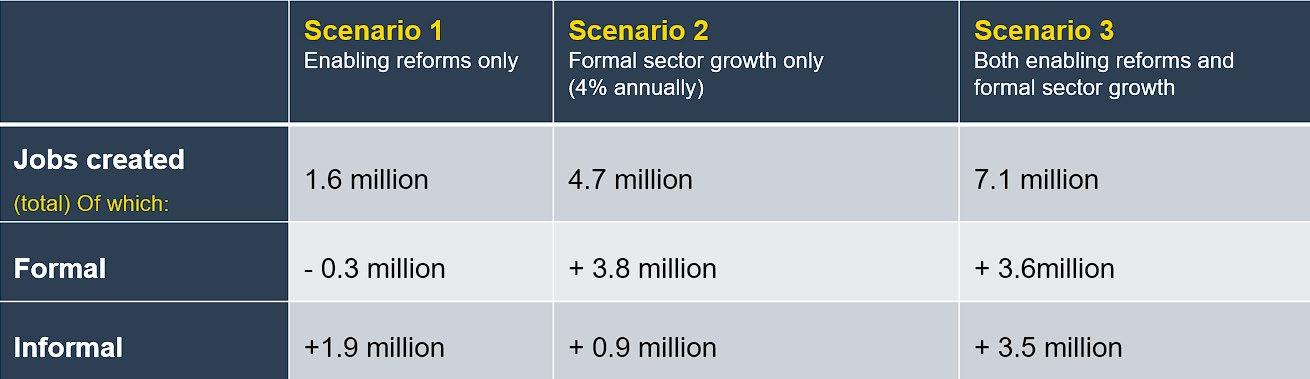
In the second scenario, formal sector growth is not accompanied by reforms of the economic environment for informal enterprises. As detailed in our previous blog, accelerated growth within the formal sector results in large gains in total employment – roughly 4% increase in employment for every 6% increase in output. Some gains accrue to informal firms, but largely via demand-boosting income effects within pre-existing markets. As the middle column of Table 1 signals, over the course of a decade, overall informal sector job growth hovers a little below the 1 million mark.
In the third scenario, the combination of enabling environment reforms and sustained formal sector economic growth has far-reaching positive effects.
The wave of broader economic expansion enables the informal economy to grow rapidly – roughly 3.5 million new jobs as per the right-hand column of Table 1, with less perceived cannibalisation of the formal sector. Over the course of a decade, the Scenario 3 combination of many more informal sector jobs, and very large formal sector employment gains would be enough to eliminate almost entirely South Africa’s excess unemployment relative to other middle-income countries.
But numerical gains conceal a continuing structural challenge. Aggregate employment matters, but so, too, does the quality of jobs.
At the outset of this blog series, we identified a three-fold economic challenge: to accelerate growth; to massively reduce excess unemployment; and to move beyond the toxic economic dualism that for centuries has bedeviled South Africa’s economy, society and politics. But even the expansive third scenario does little to address this last task, insofar as most of the informal jobs created are ‘survivalist’. Our next blog post will explore the potential of one aspect of the ICT/AI connective revolution to help address the remaining gap – namely its impact at the interface between the formal and informal economies. As we shall see, while the revolution will do little to increase aggregate employment, it has considerable potential to help strengthen the long-missing ‘productive middle’ of the labor market – and in so doing open up new ways to make some inroads into the economic dualism that has long bedeviled the South African economy and society.