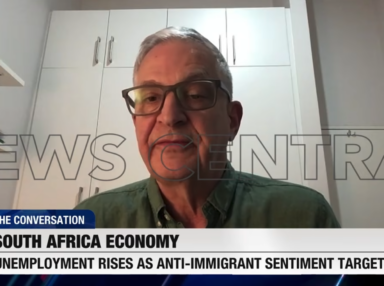
Alan Hirsch assesses South Africa’s migration plan in 702 interview and EWN article
On 26 August 2026, Professor Alan Hirsch, Senior Research Fellow at the New South Institute (NSI) and Head of its Migration Governance Reform programme, joined Africa Melane on Early Breakfast with Africa Melane, broadcast on 702 and CapeTalk, to assess the implementation of President Cyril Ramaphosa’s five-point migration plan.
The interview followed Ramaphosa’s appearance before the National Assembly the previous day, where MPs questioned the government’s response to irregular migration and the growing tensions surrounding migration in South Africa. The president’s plan, announced in June, focuses on enforcing immigration law, strengthening border management, addressing corruption, closing legal and policy gaps, and improving cooperation with other African countries.
Later on 26 August, EWN journalist Celeste Martin drew on Hirsch’s interview in an article titled Ramaphosa’s illegal immigration plan makes gains, more work needed – expert. The article highlighted Hirsch’s assessment that there had been movement on some elements of the government’s programme, while significant implementation and regional governance challenges remained.
In the interview, Hirsch pointed to measures taken within the Department of Home Affairs to investigate and act against officials implicated in fraud relating to permits and visas. He also noted the establishment of the Border Management Authority as an institutional improvement, while cautioning that South Africa’s extensive and, in places, remote land borders cannot be managed through physical enforcement alone.
Hirsch also discussed reports that tens of thousands of foreign nationals had left South Africa in the months surrounding the 30 June deadline promoted by anti-immigration groups. He cautioned that these departures had taken place in an environment of heightened hostility towards migrants, including people who were legally present in the country. The question of migration enforcement, he argued, therefore also has to be considered alongside public safety and the risks associated with anti-foreigner mobilisation.
A central part of Hirsch’s argument concerned regional cooperation. Most irregular migration into South Africa originates in neighbouring Southern African countries, making the Southern African Development Community (SADC) an important institution for developing more coordinated responses. Hirsch recalled that regional discussions on the movement of people date back several decades, including proposals for freer movement in the 1990s and a subsequent migration facilitation framework. In his assessment, however, regional implementation has remained limited.
He argued that migration between South Africa and neighbouring countries also needs to be understood in its historical and economic context. Labour migration to South Africa has been part of the regional economy since the nineteenth century, and households and communities in countries including Lesotho, Mozambique and Malawi have long depended on income earned in South Africa.
For this reason, Hirsch argued that enforcement measures alone cannot provide a durable response to irregular migration. Greater economic development in neighbouring countries, accompanied by stronger regional cooperation and appropriate forms of South African technical and economic support, would reduce some of the pressures that encourage people to migrate in search of employment.
The interview also addressed changes to South Africa’s migration policy framework. Hirsch referred to the migration White Paper approved by Cabinet earlier in 2026 and the further legislative work required to translate policy proposals into practice. As with border management and anti-corruption measures, he emphasised that the effectiveness of these reforms will depend on the state’s capacity to implement them.
These questions are closely connected to Hirsch’s work through NSI’s Migration Governance Reform programme, which examines migration not only as a question of border enforcement, but also as a matter of governance, institutional capacity, regional cooperation and economic development. The 702 discussion situates the government’s current measures within this broader question: how South Africa and its neighbours can move from short-term responses to a more coherent regional approach to migration.
Watch: Alan Hirsch on Early Breakfast with Africa Melane on 702