Building Shared Prosperity in South Africa (4/5) – Overcoming Dualism: The Connective Revolution’s Transformative Potential
By Brian Levy and Alan Hirsch
To open up a pathway to shared prosperity, South Africa needs to address three intertwined crises: economic stagnation, massive unemployment, and extreme economic and social dualism and inequality. As earlier posts in this series argued, successfully addressing the crises will require accelerating growth – but growth alone will fall way short of generating the job increases needed to make a decisive dent in unemployment. Alongside growth, improving the economic environment for informal enterprises can go a long way further – but most of the resulting employment gains go to ‘survivalist’ microenterprises, so the extreme dualism of South Africa’s economy and society will persist.
How, then, to address the third crisis? This post will argue that a connective revolution at the interface between South Africa’s township and higher-income formal economies – one facet of the broader digital revolution now underway – offers one promising way to help break down the barriers that sustain economic dualism.
It is all too easy to imagine how a digital revolution (ICT, including artificial intelligence) might make things worse; not only does ICT introduce a new dualism between technological haves and have-nots, it also accelerates automation and labour displacement. But there is also the counterexample of India, where an ICT revolution has fuelled an acceleration in growth, productivity and incomes across broad swathes of the economy (see here, here and here). South Africa’s economic challenges are, of course, radically different from India’s. Even so, South Africa’s distinctive crises also bring a distinctive opportunity.
As we argue below, it is precisely because South Africa’s legacy of dualism has been so extreme that a connective revolution at the township-formal economy interface potentially has a large upside, with limited downside risk.
The past decade has witnessed sustained efforts to identify the implications of the ICT connective revolution for economic growth and job creation. (See the 2016, 2021 and 2026 World Development Reports for some landmark syntheses of the possibilities, and the policy requisites for realising them.) But until recently there has been a striking disconnect. As a 2021 report published by the International Labour Organization (ILO) puts it:
“The report bridges hitherto siloed debates on the global digital revolution and on informal enterprises and micro and small enterprises (MSEs). [It] puts forward two models of how digitalization can lead to productivity gains in MSEs: one based on an enterprise’s internal capabilities, the other on how external (environmental) influences affect MSEs.”
In what follows, we apply both models to South Africa.
As our previous blog post detailed, the terms ‘informal sector’, ‘township economy’ and ‘survivalist micro-enterprise’ often are used interchangeably, in ways that can undercut the notion that the informal sector can be a source of transformative dynamism. To be sure, three-quarters of South Africa’s informal sector enterprises are indeed ‘survivalist’. But that leaves a remaining quarter. In his books on “kasinomic” revolution, Alcock has vigorously championed the latter’s transformative power:
“…the kasipreneurs who have visions of scale and growth…a world of small people doing big things…. They are building the South African economy…we often see them as hustlers, small-time operators – or we don’t see them at all…. We [fail] to recognize entrepreneurship in its unromantic starting point…. We glorify Steve Jobs who started in a garage, but we do not glorify Sam in his converted garage bakery” (pp.11; 70)
Alcock offers many inspiring mini case studies, but do they add up to more than the sum of their parts? Later in this post we explore some aggregate patterns – but first we need to look more systematically at interactions between kasipreneurship and the connective revolution from a micro-perspective.
The connective revolution has the potential to reduce the transactions costs of doing business and thereby increase incomes and enhance productivity both within the township economy and at its interface with the formal economy. The mechanisms include:
- How firms link to markets – the connective revolution can both help reduce transactions costs within existing markets, and provide access to buyers who hitherto had been out of reach,
- How firms access finance – with fintech innovations making reliable, real-time information on business transactions, identity and performance newly available to potential lenders, reducing risks and increasing their propensity to lend to informal firms.
- How firms manage a broad range of additional business functions – including input sourcing, delivery to customers, inventory, accounting and record keeping more broadly.
Realising the potential requires both entrepreneurial small firms and a robust digital platform. Alcock’s research offers hope vis-à-vis the former. And though there continues to be much unevenness, South Africa already has gone a long way in putting the latter in place.
Digital infrastructure reaches the entire country. In late 2025, there were 127 million active mobile phone connections (almost two per person given a national population of about 66 million) almost all connected via 3G, 4G or 5G broadband networks. Over 50 million people used the internet. Only 3.5% of households had no phone connections of any kind into their home. To be sure, the costs of connectivity were relatively high – $1.30 per gigabyte of data, as compared with 0.40c per GB in India (but $1.55 in Kenya). Even so, as Alcock details and the examples below illustrate, low bandwidth and low-cost messaging can be enough to enable the connective revolution to add value within the informal economy.
Take the example of the country’s ‘fintech’ platform. In recent years, there has been explosive growth in the number of small businesses who accept payments using debit/credit card machines rather than cash: as of 2015, about 250,000 small businesses used card machines; by 2026, the number had risen to over 1 million. Independent start-up Yoco was founded in 2013. By 2026, it had over 200,000 customers, processed close to R40 billion annually through its platform – and had expanded its business from payment processing to providing business services and providing short-term cash advances on the basis of real-time information on business transactions and revenues. A second fintech payments start-up, Ikhokha, was taken over in late 2025 by Nedbank in a R1.6 billion all-cash transaction. Another large-scale bank, Capitec, South Africa’s leader in providing banking services to small businesses, recently reported that along with its half million small business clients, over 1.4 million additional customers use their personal accounts to conduct business. Capitec describes its banking services as providing ‘a major opportunity for inclusive growth and job creation….… giving the missing middle of the economy the low-friction digital tools they need to scale, create jobs, and thrive’.
Siya Dhlamini’s Chilla hang-out outlet business (one of Alcock’s many case studies) illustrates vividly how fintech, and the digital revolution more broadly, can support township enterprises. Here, in Dhlamini’s own words, is how he built the business:
It was 2017. We made a decision to start a business. We called it Siya’s Snack Shop… After a few months the business was doing okay, but needed marketing… People want a new generation of kotas [an improvised fast food meal]. I went on Facebook and searched, checking out all the kotas out there so I could work out what to do differently… I started making videos about our kotas and posting them on Facebook… When COVID came, I put my WhatsApp number on my Facebook page and then people could send me ipini and their order…
As Alcock goes on to detail, within a short time
“Siya had five outlets and a fleet of bicycles delivering around Soweto. A lot of his sales are paid for by debit card, and he has a financial services card acceptance and stock management device. The transactions processed on that device enabled him to get a loan from financial services firm which is how he could finally get a treasured bakkie for his business”. (pp. 54-55)
Along with supporting kasipreneur businesses such as Siya’s Chillas that operate almost entirely within the local township economy, ICT-fuelled businesses also straddle township- and higher-income markets.
Sometimes, the direction of trade is from the higher-income economy to township communities. Take the example of Takealot, South Africa’s largest online marketplace, with over 6 million active customers and about 15,000 active third-party sellers. Until very recently, Takealot’s principal township focus has been on cultivating buyers. In 2024, it launched a personal shoppers programme to encourage purchases by township residents unfamiliar with online shopping – and offered a commission on facilitated purchases. By September 2026, the programme had over 16,000 participants.
Whether programmes such as Takealot’s fuel or undermine the township economy is, of course, ambiguous. But when ICT connects township and small-scale productive capacity to wider markets, the benefit to the township economy is unambiguously positive (less so, though, for formal sector firms and workers who may be displaced by the cutting-edge competition). The cases below illustrate the wide variety of ways in which township-to-formal-market-connectivity can add value:
- Kandua: an online platform that links reliable (but not necessarily formally qualified) plumbers, electricians, builders and other artisans to high-income markets; it provides vetting, customer ratings and reviews, digital matching, quotation and payment tools. Founded in the mid-2010s with some venture capital funding, in 2023 Kandua was purchased for R42 million by the large-scale insurance company, Santam – transforming its principal activity from homeowner artisanal work to the vetting and response (using its skilled 10,000-person artisan network) of insurance claims.
- Abalobi: founded in 2015 through collaboration between an academic fisheries researcher, a government fisheries manager, a community activist, and small-scale fishing communities. It began as a means for fishers to record and document their catches digitally. It subsequently developed Fish With A Story, which connects small-scale fishers directly with restaurants, retailers and consumers, while providing the traceability, information, coordination and quality assurance sought by high-end sophisticated buyers. As of 2024, Abalobi was working with more than 1,600 South African fishers.
- The Motor Spares Collective: helps independent township mechanics to aggregate purchasing, order genuine parts through WhatsApp, and obtain rapid delivery, thereby enabling them to provide a timely and competitive service to car owners needing parts and repairs – and compete in a market that previously had disproportionately been served by established formal businesses. Launched in late 2024, it currently has a few hundred members and is expanding rapidly.
- Takealot: perhaps belatedly, has turned its lens around, and initiated two supplier development programmes. Its 2024 Township Economy Initiative aimed to ‘foster local manufacturing, supporting local businesses and creating jobs’ in underserved communities. In early 2026 it launched the Takealot Seller Growth Programme, with Naspers Labs and GIBS. The programme began with an intake of 225 entrepreneurs; training support ranges from general management capacity building to digital marketing and online platform strategy more broadly.
(See the World Bank’s 2023 report, South Africa: Private Digital Platform Assessment, for a systematic, multisectoral qualitative review of how ICT platforms are supporting enterprise growth in South Africa’s township economy.)
Moving from the micro to the macro, do the encouraging gains documented above add up in aggregate to more rather than less than the sum of their parts?
One (somewhat simplified, given ICT’s ubiquity) way to get a sense of the aggregate impact on the overall labour market is to characterise the ‘connective middle’ as a distinctive economic sector – one that inhabits an intermediate labour productivity space between formal and survivalist firms. Using this approach, Table 1 lays out some estimates of the 10-year impact on job creation of the ‘interface’ connective revolution. (An accompanying technical annex lays out the parameters, assumptions and calculations that underlie the table’s estimates.)
Table 1: Illustrative 10-year impact of the ‘interface’ connective revolution on employment
(4% formal sector growth and liberalized informal economy; number of jobs, millions)
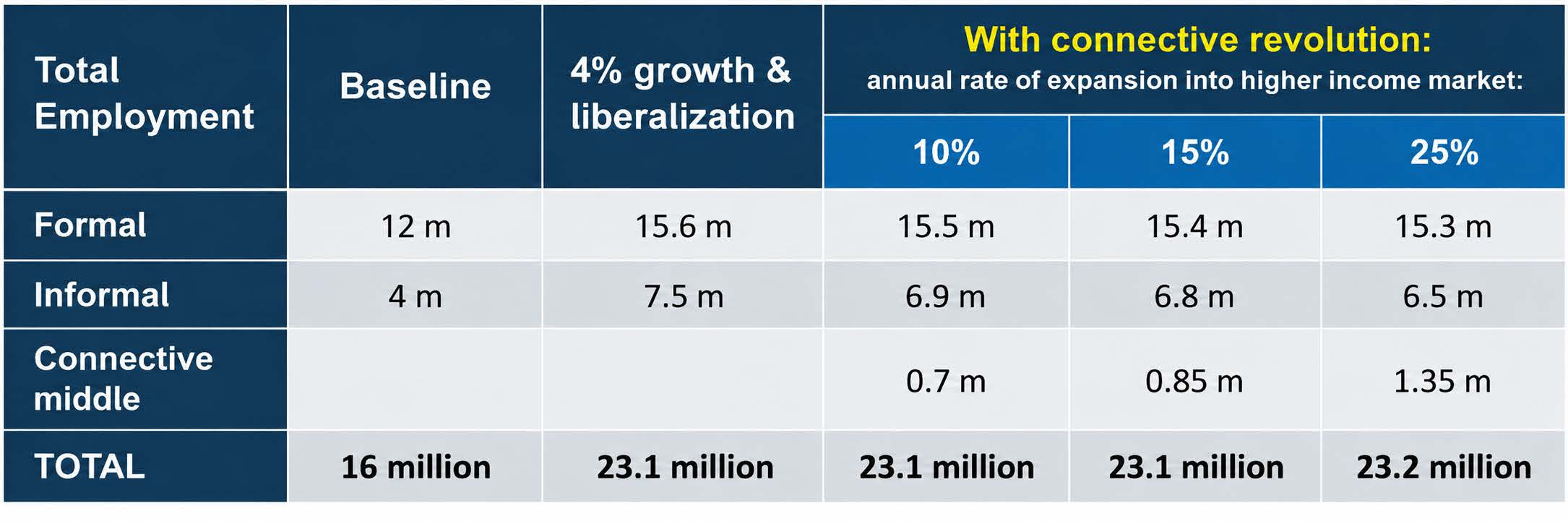
The table takes as its point of departure the expansive scenario laid out in our previous blog post: 4% average annual growth of the formal economy, combined with far-reaching improvements of the economic environment for informal firms. As the first two columns in the table summarise, this expansive scenario results in an increase of roughly 7 million jobs over the course of a decade.
Introducing the connective revolution into the scenario affects the aggregates in three ways, all evident in the right-hand columns of Table 1.
First (and unsurprisingly) the more rapidly the connective revolution takes hold, the greater is the number of new connective middle jobs created – with the rate of expansion determined by a combination of entrepreneurial flair on the part of both formal platform-building enterprises and the stock of small firms and enhanced regulatory flexibility. As our final blog will explore further, new, proactive policies can have a substantial impact on both sets of drivers. As the estimates in the table suggest, around 1 million new connective-middle jobs is a reasonable first approximation of what may be feasible.
Second, while some connective middle jobs are wholly new, others are the result of outcompeting formal or survivalist firms. (The technical annex details the mix of ‘new’ and ‘cannibalised’ demand incorporated in Table 1’s estimates.) As the table signals, job ‘losses’ fall disproportionately on survivalist firms, and these losses can almost entirely offset the job gains in the ‘middle’. Put differently, measured in terms of the number of jobs created, the connective revolution does not offer a pathway out of South Africa’s structural unemployment crisis.
Third, the offsetting job gains and job losses alter the composition of employment. As our previous blog explored, what distinguishes South Africa from other middle-income countries is the failure of its informal sector to provide a ‘survivalist’ income floor for those on the margins of society. A far-reaching re-orientation of policy vis-à-vis the informal sector from restrictive and punitive to proactively supportive (see here and here) can go a long way to closing the unemployment gap. But if most of the resulting gains come via expansion in the number of survivalist enterprises, structural dualism remains. This is where a connective revolution at the interface could make a decisive difference. It’s about building scale and raising productivity and the incomes of the middle strata.
The connective revolution’s ability to reduce transactions costs opens up new pathways for moving beyond survivalism. It helps increase productivity near the bottom of the economy, helps fill the long-missing middle of South Africa’s labour market, and opens new channels for bottom-up entrepreneurship. It renews hope in the possibility of a better life.
South Africa’s apartheid legacy has long made the costs of bridging the divide between the formal and township economies inordinately high, except under narrowly circumscribed terms that favoured the interests of incumbent formal sector firms (for example, in labour markets and retail). A connective revolution at the township-formal economy interface creates new possibilities to move beyond structural dualism and associated political economy obstacles that repeatedly have undercut the best of development intentions. How far and how fast this proceeds will depend in part on public policy. More on these political and policy dimensions in our final post in this series.