Webinar recap: Can We Build Shared Prosperity in South Africa?
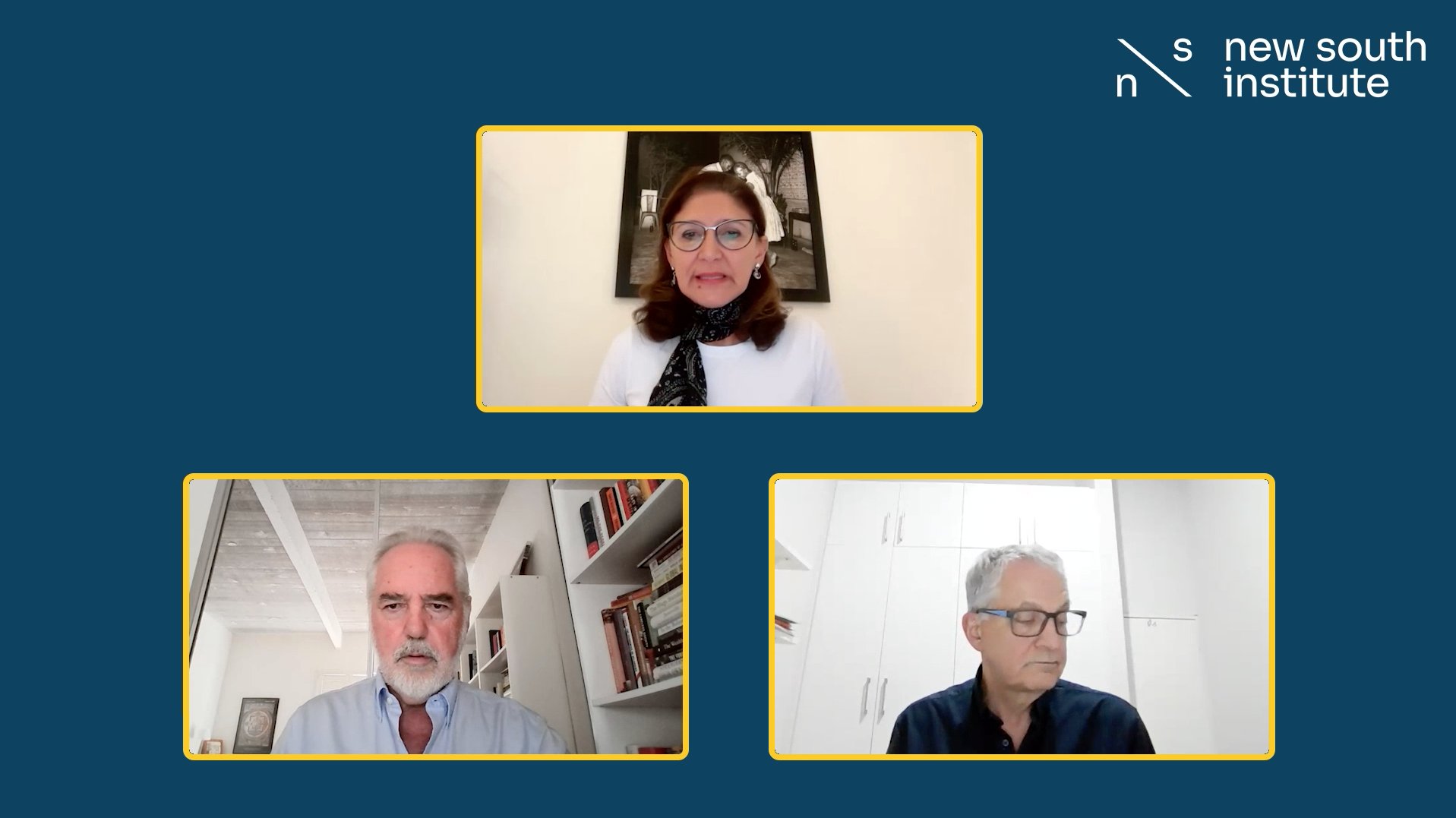
On Tuesday, 17 November 2026, the New South Institute (NSI) hosted the webinar Can We Build Shared Prosperity in South Africa?, based on the five-part blog series Building Shared Prosperity in South Africa. Ivor Chipkin, Co-Founder and Director of the NSI, opened the session, series co-authors Alan Hirsch and Brian Levy presented their proposition, and Dr Claudia Manning, Investment Principal at the SA SME Fund, moderated the discussion.
The authors argue that South Africa needs to pursue three strategies simultaneously. These are faster growth of the formal economy, far-reaching reforms to improve the environment for informal and microenterprises, and support for the information and communication technology “connective revolution” at the interface between the township economy and the formal economy. In their view, none of the three is enough on its own, but together they reinforce each other.
Growth is necessary but not enough
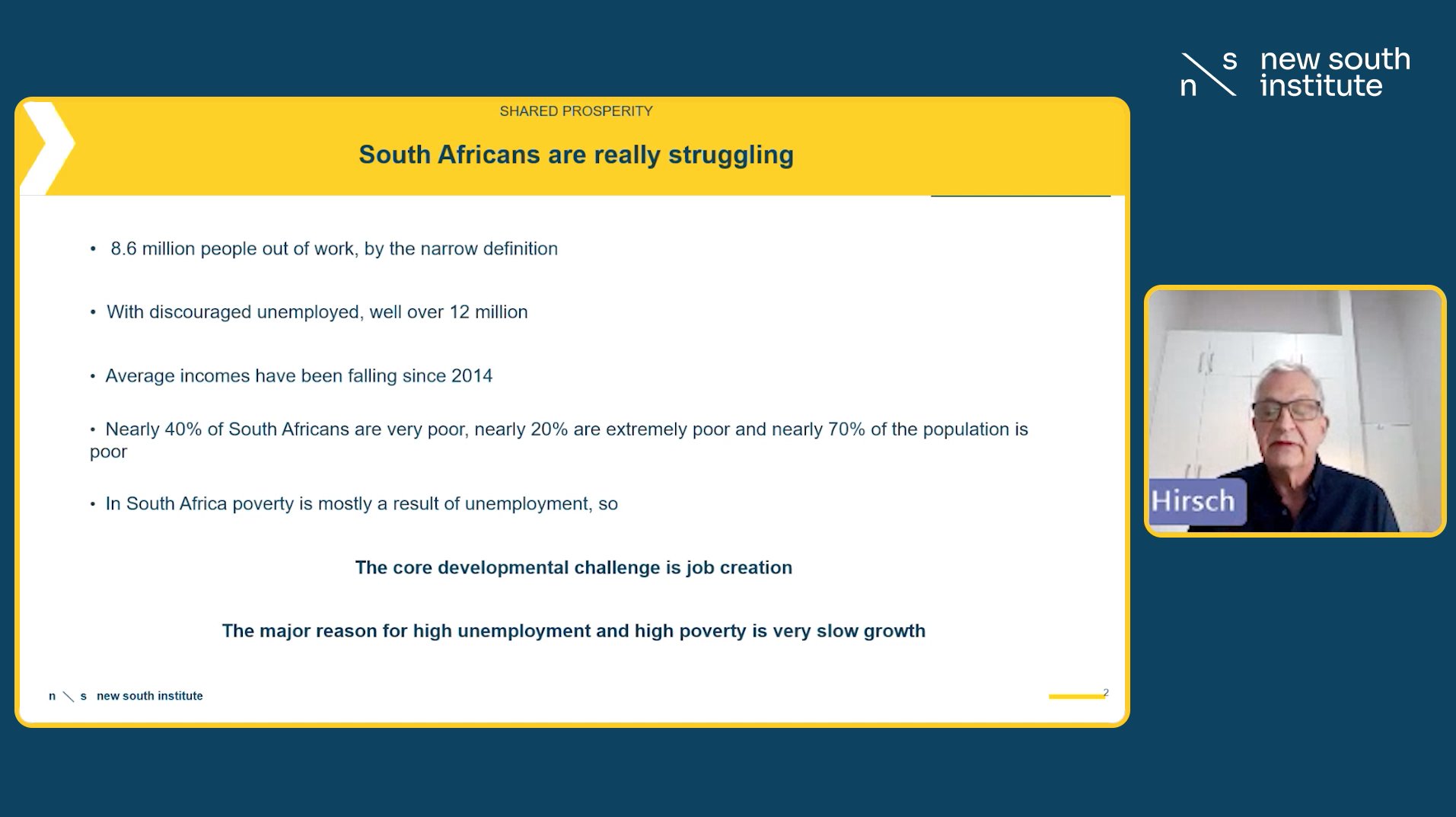
Hirsch began with an overview of the scale of the problem. By the narrow definition of unemployment, 8.6 million people in South Africa are out of work, and well over 12 million if discouraged workers are included. Average incomes have been falling since 2014, and fixed investment by both the private and public sectors is lower than any level seen since 1994.
He also pointed to changes in the global environment. Manufacturing is dominated by East Asia and increasingly automated, production is moving closer to the largest markets, and protectionism and the costs of the climate transition add to the pressure. For a middle-income country such as South Africa, export-oriented manufacturing is no longer a reliable route to mass employment. Drawing on the work of Dani Rodrik, Hirsch argued that opportunities are more likely to be found in services, agriculture and agro-processing, mining, and tourism, and that taking them up requires active partnership between government, business, labour and communities.
The authors’ estimates show why growth alone falls short. Over ten years, formal sector growth of 4% a year, a high rate by South African standards, would produce only four to five million new jobs. Combined with an expansion of the informal sector, job creation could rise to over seven million.
The informal sector and the connective revolution
Levy, who for many years argued that light manufacturing exports, such as clothing and footwear, were the path to job creation in South Africa, explained what changed his view. Research by Haroon Bhorat and colleagues at the University of Cape Town’s Development Policy Research Unit and Harvard’s Growth Lab shows that what sets South Africa apart from other middle-income countries is the unusually small size of its informal economy. With an informal sector of typical size, our pattern of unemployment would look much more like theirs.
According to Statistics South Africa, there were about 1.9 million informal businesses in South Africa in 2025, around three quarters of them single-person, survivalist operations. Levy identified the main constraints on their growth as high urban transport costs inherited from apartheid spatial planning, licensing and zoning rules, crime, and the lack of basic infrastructure such as market facilities and storage. The authors’ scenarios suggest that bold reforms in these areas, combined with 4% formal growth, could create around 3.5 million informal sector jobs over ten years.
Levy then turned to the third pillar. Low-cost smartphones, ordering by WhatsApp, and point-of-sale (POS) card devices are already changing how township businesses operate. More than a million micro-, small and medium enterprises now take card payments, which also give them a record of earnings that can support access to credit, and new platforms link informal enterprises to formal markets and suppliers. The authors estimate that this “connective middle” could account for between 0.7 and 1.35 million jobs after ten years, depending on how fast it grows. Most of these jobs would replace lower-productivity work rather than add to the total, but their value lies in creating better jobs and filling the missing middle of the South African economy.
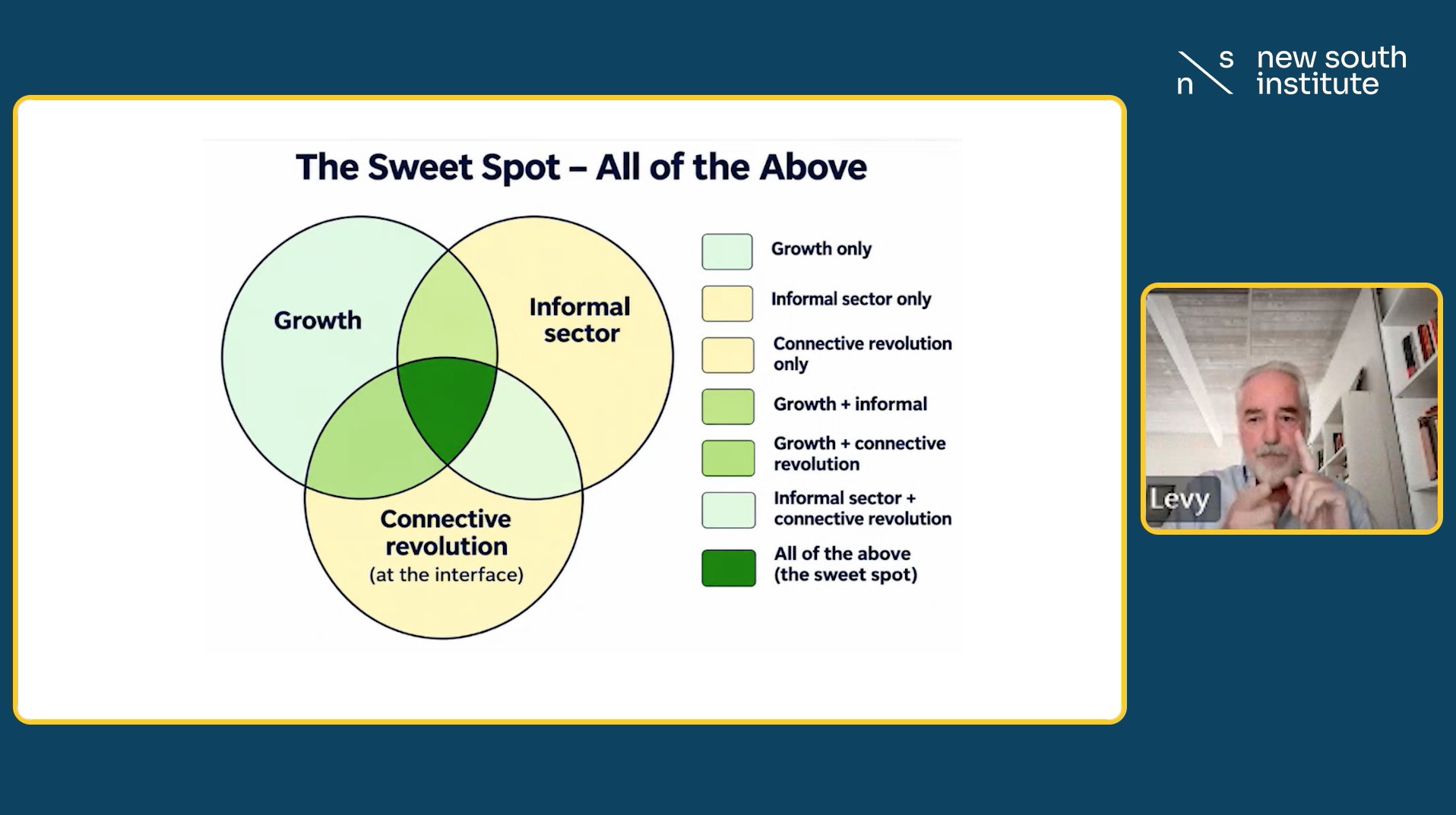
Levy summed up the argument with a diagram of the three pillars. Growth alone creates jobs but leaves in place the dualism that divides the township and informal economy from the higher-income formal economy. Freeing up the informal sector in a stagnant economy creates jobs, but also social and political friction. The connective revolution alone raises productivity but squeezes survivalist jobs. The “sweet spot” is where all three intersect.
How do we get there?
Hirsch closed the presentations with suggestions about implementation. Some reforms, for example in electricity supply and transport, can be driven from the centre through Operation Vulindlela. Others, including water and sanitation and the reforms needed to raise private investment, require joint and ongoing processes between government and business. He argued that the top-down, state-led approach of recent industrial policy has to give way to real engagement and consultation from the outset, to rebuild trust and encourage investment.
The second and third pillars depend on mobilising tens of thousands of actors. Rezoning to give informal traders organised access to commercial areas, for example, needs negotiation with formal businesses and residents, as well as action by local government on safety and facilities. Supporting the connective revolution means learning from the firms already active in this space, backing what works and adjusting along the way. Hirsch argued that pursuing the three pillars together makes it possible to show how the formal commercial sector, the poor, and better-off South Africans can all gain, but that this requires reform coalitions, endorsement from trusted leaders, and clear communication.
Discussion
Manning, who has spent much of her career working with small businesses and the informal sector, said the webinar brought together two debates that rarely meet, one on how to restart growth and one on how to help small businesses grow. She gave the example of POS devices in spaza shops. Beyond enabling digital payments, they create a record of income and expenses that allows shop owners to borrow at reasonable rates, expand their stock or open a second shop. She asked what policy reforms would support this part of the economy.
Levy noted that the main opportunity for government lies in a determined effort, not a marginal one, to transform the environment for micro- and small enterprises. Hirsch listed concrete obstacles, starting with safety, which studies consistently identify as the biggest constraint on township businesses, followed by access to electricity, roads, water and sanitation, and storage for traders. He also noted that South Africa lags countries such as India and Brazil in delivering government services online.
Manning added that responsibility for many of these issues sits with municipalities, whose bylaws often keep informal traders out of public spaces, and that capital provided through non-bank lenders is the easiest lever to pull. She recalled a COVID-19 grant for informal traders that barely reached them because applicants had to produce documents that most of them did not have.
Questions from the audience covered tourism and labour-intensive services such as health care and education, the cost of mobile data, and whether the expansion of informal enterprises simply displaces existing jobs. Levy explained that the authors’ estimates account for new markets, income gains and some displacement, as set out in the technical annexes to the series. Asked whether official statistics underestimate the size of the informal sector, he replied that if they did, South Africa would have less poverty and dualism than it appears to, which would be good news.
In closing, Levy said that writing the series meant letting go of his long-held belief in light manufacturing exports as the main route to jobs. He pointed to Franklin D. Roosevelt’s call for “bold, persistent experimentation” during the Great Depression as reflecting the spirit of the authors’ proposals.
Watch the webinar
Presentations
- Alan Hirsch, Starting the growth engine (PDF)
- Brian Levy, Three mutually reinforcing pillars (PDF)
- Alan Hirsch, How do we get there? (PDF)
Read the series
- The Challenge: Growing Jobs in a Tough World
- Going for Growth
- Jobs and the Informal Sector
- Overcoming Dualism: The Connective Revolution’s Transformative Potential
- How Do We Get There?
- Technical Annex A: Jobs and the informal sector and Technical Annex B: Employment impact of the connective interface